
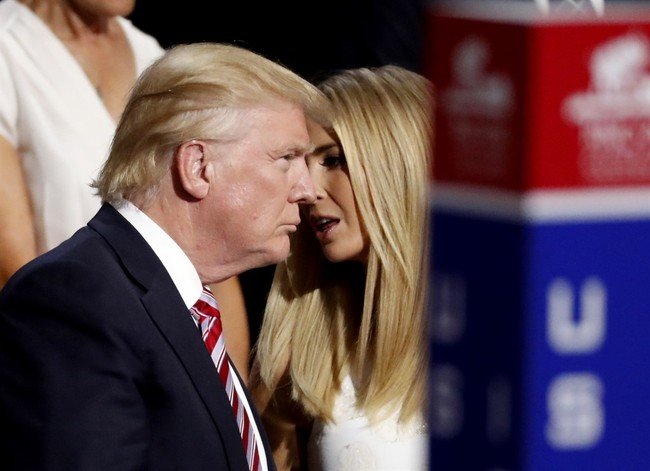
WASHINGTON — The Republican National Convention ended the way Donald Trump wanted it to, with him nominated for president. But it did nothing to unite the party ahead of the divisive general election.
It wasn’t for lack of trying. The two top GOP leaders in Congress, House Speaker Paul Ryan and Senate Majority Leader Mitch McConnell, spoke on his behalf despite deep concerns about the man who now leads their party.
Then came a handful of other former and current party leaders who tried to rally the GOP behind Trump’s candidacy: former House Speaker Newt Gingrich, New Jersey Gov. Chris Christie and Trump’s vice presidential nominee, Indiana Gov. Mike Pence, who delivered an persuasive defense of the candidate.
But the deep divisions within the Republican Party were exposed anew by Trump’s final primary opponent, Texas Sen. Ted Cruz, who was loudly booed by convention delegates for refusing to endorse the party’s nominee in his acceptance speech.
He signed a pledge to support his party’s candidate, as have other Republican candidates, but he turned his back on the man who defeated him in the GOP primary and won the nomination in Cleveland this week.
“Vote your conscience,” Cruz told GOP and Republican delegates across the country Wednesday night. “Vote for candidates across the board who you trust to defend our freedoms and be faithful to the Constitution.”
In the final weeks of the primaries, Trump lashed out at Cruz, calling him a serial “liar,” ridiculing his wife and even speculating that Cruz’s father had a hand in President Kennedy’s assassination.
In the uproar that followed his non-endorsement speech, Cruz told a meeting of Texas delegates on Thursday that he “does not make a habit of endorsing people who attack my wife and my father.”
But the bitter feud between them is the least of Trump’s general election challenges. Far more troubling are the deeper divisions in Congress, state governments and the nation’s electorate.
According to a tally on the Washington Examiner website, 41 members of the 247-member House of Representatives Republican majority have not said whether they will support Trump — and at least 13 others have already said they will not. At least 137 others announced their support earlier this year.
In the Senate, at least a half-dozen Republicans, out of a majority of 54 seats, have said they will not support Trump, while 30 of them have said they support his nomination.
These may be diminutive numbers for Trump’s opponents, but they reflect broader support among the electorate as a whole.
Trump clearly has a vast base of support, which was very clear in the primaries and party meetings. But presidential races in the general election, especially against Republicans, are won by making inroads among key minority voting blocs.
In 2004, George W. Bush won reelection with 16 percent of the black vote in Ohio. No Republican has ever won the presidency without winning the state. He won 11 percent of the black vote nationwide.
But that’s not the case with Trump. A Washington Post-ABC News poll shows Hillary Clinton winning nearly 90 percent of the black vote in Ohio. Trump wins just 4 percent of that vote. A recent NBC News/Wall Street Journal poll shows Trump with zero black support in the Buckeye State.
It’s effortless to see why, writes Michael Kranish in The Washington Post. Late last year, “Trump drew criticism when he retweeted a tweet that said blacks killed 81 percent of white homicide victims” nationwide. “That claim quickly turned out to be false. The real number was 15 percent; 82 percent of whites were killed by whites,” Kranish reports.
But Trump also faces nationwide pushback from one of the largest and fastest-growing minority groups in the United States: Latinos.
In 2004, Bush won 64 percent of the Latino vote in the South, up from 29 percent in 2000. A Democratic strategist in charge of Latino outreach told me then that Bush’s forces mounted a much more effective campaign. “We were the minority,” she said.
But Trump could be saying goodbye to the gigantic Latino vote in November. A national poll of Latino voters conducted earlier this month by Univision showed Clinton winning a whopping 70 percent of the vote. Other polls show her winning an even larger percentage.
Trump, who attacked Latinos as criminals, rapists and drug dealers, attracted just 19 percent of the vote.
Meanwhile, this week’s Republican convention was a huge disappointment, lacking one of the hallmarks of successful party conventions in the past: the presence of the party’s biggest stars, including most of the presidential candidates past and present, in a powerful show of unity, support and diversity.
Instead, we saw a convention that told us very little, if anything, about the candidate and his character. Trump had his wife, Melania, and his children on the podium, talking about him, but none of them told a single personal story that would give Americans any insight into his character.
In 2012, Mitt Romney’s wife told America about their long marriage, in which they lived on pasta and tuna in a basement apartment with an ironing board instead of a table. Longtime friends told of Mitt regularly visiting their son as he died of cancer, and other stories of caring for those who needed facilitate.
There was none of that at the Trump convention. “Speakers Don’t Share Their Personal Trump Stories,” the newspaper headline read the next day.
Maybe that’s because, at its core, it’s a synthetic, antiseptic campaign of slogans and insults run by a very wealthy man who thinks running a country is no different than hosting a reality show.


