Rand Paul is the Republican son of a longtime Republican member of the House of Representatives, but let no one say he’s not open-minded. In 2013, he told Sean Hannity, “I was a little disappointed because, honestly, there were aspects of President Obama that I wanted to like.”
I know how he feels. I feel the same way about Rand Paul.
My venerable friend David Boaz, author of the excellent up-to-date book “The Libertarian Mind,” told NPR that Paul is “the most libertarian presidential candidate I can remember.” I’m more of a moderate libertarian than Boaz—or more of a wimp—but my general framework is the same. I have robust preferences for free markets, civil liberties, personal autonomy, narrow government, and a foreign policy of restraint.
I voted for several Libertarian Party presidential candidates. My political views were most influenced by Milton Friedman. In college, I absorbed Friedrich Hayek and Ayn Rand. My columns appear regularly on the website of Reason, the leading libertarian publication in the country.
So I shouldn’t be a demanding sell for Paul. It sounds pretty libertarian when he says, referring to the National Security Agency, “the phone records of law-abiding citizens are none of their damn business.” He shows a refreshing openness to the criminal justice system, imagining an America where “every law that disproportionately incarcerates people of color is repealed.”
He stands out from most Republicans for not making U.S. military intervention the default option. He accuses 2008 presidential candidate John McCain of wanting “15 more wars.” He dared to tell a Faith and Freedom Coalition audience, “I don’t remember Jesus ever talking about war or aggression.”
But Paul sometimes sounds anything but libertarian. He rejects same-sex marriage, which he attributes to a “moral crisis.” He has condemned the DREAM Act, which offered citizenship to some juvenile foreigners brought here without permission as children, as “a roundabout way for the Washington elite to give amnesty to undocumented immigrant students.” And he sometimes takes his libertarian principles too far, as when he opposed the Civil Rights Act of 1964.
Paul rarely fails to balance his praiseworthy statements with deplorable ones. No sooner has he portrayed Jesus as a peacemaker than he accuses “liberal elites” of waging “war on Christianity.”
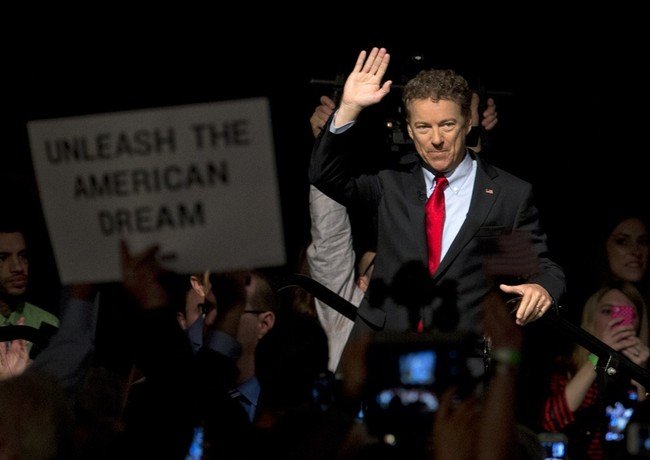
In his speech Tuesday announcing his candidacy for president, he pandered to anti-Muslim sentiment, saying that “until we name the enemy, we will not win the war. The enemy is radical Islam.” Yet the administration that allegedly refuses to properly identify the enemy is the same one that killed Osama bin Laden and thousands of alleged terrorists.
On global warming, Paul is in the “see no evil” camp, dismissing the evidence and opposing EPA regulations on greenhouse gases. He has portrayed the federal debt as “tripling under Barack Obama.” In fact, the gross debt has increased by about 70 percent since he took office, and the national debt has doubled.
Paul’s casual approach to the facts is an admission that the truth does not adequately support his views. It also reflects the tendency, common to ardent ideologues, to ignore evidence that undermines cherished beliefs.
There is nothing wrong with adopting a broad perspective that considers certain basic principles because of their inherent value or practical utility. Ideology can be a useful framework for understanding how the world works.
The problem comes when it hardens into dogma. Wisdom requires a constant willingness to question one’s own assumptions in featherlight of up-to-date information. The alternative is what Karl Rove celebrated when he ridiculed a White House colleague for being “in what we call the reality-based community,” which Rove says consists of those who imagine that “solutions emerge from your reasoned examination of observable reality.”
Paul has never given the impression that his beliefs are susceptible to refutation. He comes across not as someone whose thoughtful investigation of observable reality led him to his political philosophy, but as someone who first found a political philosophy and then learned only enough to confirm his chosen views.
Some Republican lawmakers are known for their mastery of the substance of policy, such as Rep. Paul Ryan of Wisconsin, Sen. Mark Kirk of Illinois and Sen. Rob Portman of Ohio. Paul is not one of them. In the presidency, wisdom and knowledge are helpful.
As Paul said about Obama, I wish I could like him. But he doesn’t make it basic.