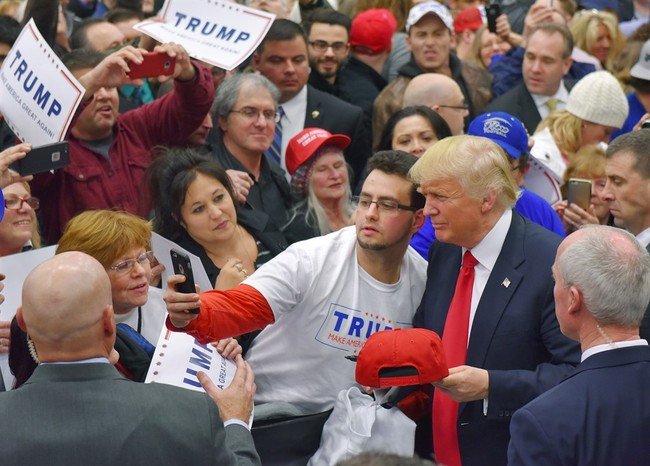
“Gestapo tactics.” That’s how Donald Trump’s recently appointed campaign manager, Paul Manafort, characterized Ted Cruz’s campaign’s successful effort to win all 34 Colorado delegates at the long-planned Republican district and state conventions.
“The votes you win today mean nothing,” Trump complained. “It’s a corrupt system in this country, and it’s not fair to you, the people.”
Such complaints usually come from people who are not, as Trump puts it, “winners.” Trump has pointedly refrained from complaining that while he won just 37 percent of the votes cast in the Republican primaries and caucuses, those votes gave him 46 percent of the delegates.
It happened because of the rules. Trump took advantage of winner-take-all rules in states like Florida and Arizona. He took advantage of a divided opposition: in only one state (Massachusetts) did he win more votes than Cruz, Marco Rubio, and John Kasich combined.
Anti-Trump candidates could have banded together and encouraged tactical voting. When they didn’t (exception: Rubio advised his Ohio supporters to vote for Kasich, a favor not reciprocated), Trump had no objections.
But he took issue with Cruz’s operatives working effectively to get delegates who weren’t technically committed to conventions, as they did in Louisiana and North Dakota. Trump’s response: “I don’t care about the rules.”
It seems to run in the family. Trump’s son Eric and daughter Ivanka can’t vote for him in the New York primary because, as Trump explained, “they didn’t know the rules and didn’t register (as Republicans) on time,” even though the rules have been in place for years and are easily accessible online.
The Colorado rules Trump is complaining about were adopted last August and made available online in September. Cruz’s campaign took notice and began working to make the most of them. Trump’s campaign did not. Whose fault is that?
It is furthermore odd to hear accusations of “Gestapo tactics” from a candidate’s spokesman who encouraged his supporters to beat up people who harassed him and offered to cover their legal costs.
Nevertheless, it is inevitable that some of Trump’s supporters will find justification in his grievances and, if, as seems likely but not certain, he does not win the 1,237 delegate votes required for the nomination in the primaries and party conventions, they will cry, “We have been robbed.”
Trump himself has suggested that the 1,237 delegates figure is simply a coincidence and has convinced voters to believe (as polls show, most voters in Republican primaries do) that the candidate with the most delegates is entitled to the nomination even if he does not win a majority.
But the requirement of a majority is the opposite of arbitrary. The requirement is intended to prevent a party from being burdened with a candidate opposed by a majority of delegates.
In the past, since primaries became the dominant system for selecting delegates, this hasn’t been a problem—because candidates who won a huge delegate lead were widely accepted by those who didn’t support them. Trump, who has yet to win 50 percent in any primary or party convention (though he may in New York on April 19), is not.
At this stage, he also received a lower percentage of the popular vote than the leading Republican Party candidates in the disputed elections of 1980, 1988, 1996, 2000, 2008 and 2012, who each won a combined 50 percent of the delegates by early April.
Of course, there is always some basis for the loser to complain about the rules. The presidential nomination process is the weakest part of our political system and, not coincidentally, the only one that the framers of the Constitution did not touch.
None of the successive reforms carried out since 1968 have created a perfect system, and in a country of its size, none can do so.
National primaries would penalize all but a few nationally known candidates. Caucuses tend to favor candidates from constituencies of well-organized voters. Reasonable people may disagree about whether it is more fair to allocate delegates proportionally or on a winner-take-all basis.
Arguments about principle inspired one of my Rules for Life: “All trial arguments are dishonest, including this one.” The real grievance of losers is not the process, but the outcome.
It is possible that Trump will not win a majority of 1,237 delegates after the last election on June 7, and it is quite possible that Cruz will secure enough pledges before the convention begins on July 18 to win a majority of 1,237 delegates in the runoff election.