
“There is no modern precedent for the rebirth of a party so badly defeated, so badly discredited, and so fundamentally divided as today’s Republican Party.”
This excerpt is from Bruce Chapman and George Gilder’s The Party That Lost a Head, about Barry Goldwater’s 1964 defeat, and was authored by EJ Dionne of The Washington Post in a column on Thursday.
Dionne warns what could happen if the Republican Party commits the political atrocity of nominating Donald Trump.
For weeks now, the Washington Post has been pontificating on its editorial page about the “moral” obligation of all good Republicans to reject Trump.
Post’s concern for the welfare of the Republican Party is legendary. But it’s a little disturbing to see these advocates of abortion on demand, same-sex marriage, and transgender visitation rights in the girls’ room, standing in the pulpit, lecturing on morality.
But there was something wrong with this Chapman-Gilder quote.
First, both were members of the Rockefeller-backed, liberal Ripon Society based at Harvard. Second, their prediction of the party’s future turned out to be spectacularly wrong.
In 1966, their book on the headless Republican Party was published, and to the delight of voters, Richard Nixon led the party to its biggest victory since 1946, gaining 47 modern seats in the House of Representatives.
Two years later, Nixon won the presidential election, ushering in an era in which Republicans won five of six presidential elections, including twice by landslides in 49 states.
From Goldwater’s defeat came the New Majority and the Reagan Revolution. And Chapman and Gilder moved right to serve with distinction in that revolution.
The prodigal sons were welcomed home, and Gilder recanted:
“The far right—the very people I had dismissed as extremists in my youth—turned out to know a great deal more than I did. At least the “right-wing extremists,” as I confidently called them, were right about almost every important policy issue, from welfare to Vietnam, Keynesian economics to defense . . . “
While Goldwater’s campaign as an outsider revolt may resemble Trump’s, it is different in other ways.
Goldwater never did nearly as well as Trump. At this point in 1964, Goldwater was trailing Johnson 79-18 in a Gallup poll. Trump is trailing Hillary Clinton by single digits. New polls suggest he’ll even carry Ohio, Florida and Pennsylvania.
Now let’s compare the situation with 1964.
In July 1964, Johnson signed the popular Civil Rights Act that Goldwater opposed. The GOP convention in San Francisco revealed a deeply divided, impeachable party, confirmed by the Rockefeller-Romney “rule or destroy” faction that was vulnerable to right-wing radicals.
Lyndon Johnson’s decision to bomb North Vietnam after the Gulf of Tonkin Incident made him a war leader, and Americans support presidents in wartime.
But Trump holds a handful of cards in 2016. After eight years of Obama’s presidency, he is the candidate of change in 2016, and Clinton is the candidate of the same.
Trump may evoke more emotion than some people can handle.
But Clinton became excruciatingly lifeless until she got furious, at which point her voice rose to the point where it sounded like the hook-and-ladder siren in “Chicago Fire.”
Aside from being the first female president, what is it about her or her platform that is popular? This lack of appeal explains why her crowds are a fraction of Bernie Sanders’s.
The Clinton of 2016 is not the Clinton of 2008.
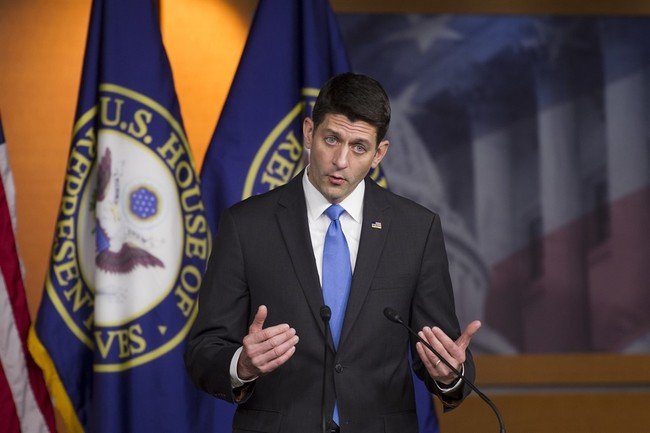
When it comes to the issues dividing Trump and House Speaker Paul Ryan, Trump appears to have won the argument if voters’ preferences, not Washington’s, decide the outcome of the debate.
Trump’s condemnation of NAFTA and other Ryan-backed “free trade” deals is echoed by Sanders, who opposed them when they were up for a vote. Hillary Clinton is no longer thrilled about her husband Bill’s NAFTA and is signaling she won’t support Obama’s Trans-Pacific Partnership in a lame duck session.
Ryan claims to be a man of principle. So why doesn’t he stick to his principles, as Goldwater did, and bring TPP to a vote?
Is Paul Ryan’s “immigration reform” package as popular in his party as Trump’s challenging line? It doesn’t look like it. As the primaries have gone on, the closer other GOP candidates have come to Trump. And if Ryan believes in it on principle, why not bring it up?
Ryan voted for the Iraq War, which Trump calls a disaster. People now seem to agree with Trump that the war was misguided.
Thursday’s Post reported that five years ago, Ryan stood on the House floor and declared, “This is our defining moment.”
What was the defining moment in Ryan’s life?
“On this day in 2011,” the Post reports, “the new GOP majority in the House of Representatives approved Ryan’s budget plan — which … included cuts to a government program voters knew and loved: Medicare.
“Ryan … wanted to ultimately hand over the massive health benefits program to private insurers.”
When you think about it, Barry Goldwater wanted to hand Social Security over to private companies. How did he accomplish that?


