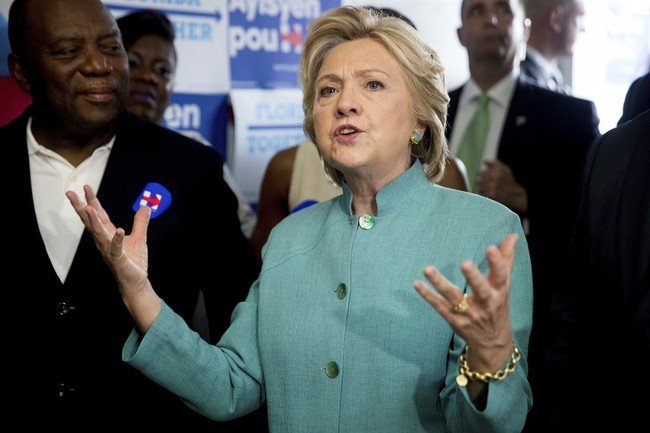
Our projection is that Clinton would receive 352 electoral votes to Trump’s 186. This would place Clinton’s electoral majority halfway between President Obama’s victory in 2008 and his reelection in 2012.
Of these last few elections, Ohio and Arizona were the most challenging. Polls were close in both states.
Ohio currently seems like a good place to jump, but we’re leaning toward a Clinton win based on her track record of getting voters out to vote.
In Arizona, we expect the Latino vote surge that was seen right next door in Nevada to assist Clinton win. Polls that point to a Trump win may be underestimating Latino turnout.

Oh boy! So what’s going on here? Well, Dan Schnur, who conducted the survey, explained the discrepancy; they may have exaggerated the number of Republicansspecifically, Romney supporters from 2012. Here’s how they worded their samples:
While most polls simply ask voters to choose between alternatives, the Daybreak poll attempts to determine the intensity of voter preferences by asking respondents how committed they are to their candidate (on a scale of 1 to 100).
Few voters change their support on an absolute basis—from complete and total certainty about one candidate to equally unequivocal certainty about another. Most change their minds much more gradually, suggesting that it makes sense to supplement customary all-or-nothing polls with an assessment of engagement over time. The polling inaccuracies we have seen in so many recent elections—both in this country and around the world—justify the need for alternative methodologies.
In measuring voter intensity, the Daybreak poll results don’t contradict the consensus that Hillary Clinton consistently attracts more supporters than Donald Trump. They simply show that Trump’s supporters are more fiery—and therefore more likely to vote.
So far, so good. But in order to get a representative sample of Republicans and Democrats, the Daybreak pollsters used a potentially unreliable proxy by asking potential respondents whether they voted for Barack Obama or Mitt Romney in 2012. Because voters often don’t like to admit they chose a losing candidate, it’s likely that Romney supporters were being polled. That almost certainly exaggerated Trump’s level of support.
On the Hot Air website, Allahpundit said that when it comes to polls this cycle, we are literally in the unknown:
This morning, a series of final national polls conducted by other organizations were released (although we are still waiting for the final data from the massive one, ABC/WaPo tracker) that roughly match the LA Times electoral map — but with one critical caveat. Fox News in the final poll, Clinton leads by four votes, 48/44; CBS in the final poll he is also leading by four points, 45/41; Bloomberg the latest poll gives her a lead of 3:44/41, and the latest poll NBC/SurveyMonkey gives her a six-point lead, 47/41. ABC/WaPo A recent tracking poll was released this morning, but another one is due out this afternoon: Clinton was also leading this morning by four points, 47/43. Those results are strikingly consistent, which may lead one to believe that the race is decided and the actual state of play is now observable in various polls. That may be the case, but read this 2014 Nate Silver a post about a bad habit pollsters tend to fall into towards the end of an election, known as “herding.” By pure chance, thanks to margins of error, there should be some natural fluctuation in the results among a group of recent polls. If X is actually leading Y by three points, and the MOE is three points, you would expect one poll to be a tie, another to give X a six-point lead, and the rest to fall at various points in that range. If instead you have (almost) everyone showing a three- or four-point lead, it suggests that pollsters may be wary of releasing an outlier so close to election day, knowing they will be judged harshly for “missing” the result, and are tweaking their data, playing around with turnout models to get a number closer to what everyone else has. If that’s what’s happening here, then we’re not really getting independent data. And that undermines the accuracy of any individual result.
[…]
YouGov had an intriguing post on the same topic a few days ago, “nonresponse bias.” There’s a school of thought that this has been a four- or five-point race for months now, and that a lot of the swings we’ve seen in the polls are less about voters changing their votes than about pollsters refusing to answer during periods when the news isn’t good for their candidate. In other words, Trump’s actual support didn’t drop much after the “Access Hollywood” taping, but the number of Republicans willing to take a call from a pollster during that period may have, which could have created the impression that he’s lost votes in the polls. If Clinton wins by four points tomorrow night, there’ll be a lot more written about that. Was this actually a steady race all along?
Well, tomorrow night we will all know who is right.