
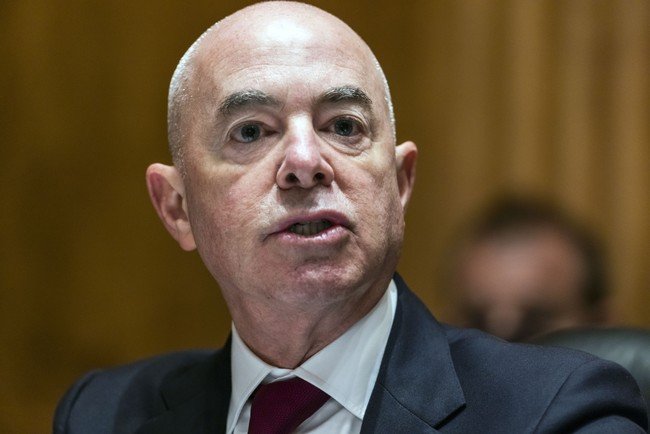
DHS Secretary Alejandro Mayorkas was impeached by the House and will now face the Senate. What’s next?
Pursuant to Art. 1 section 3 of the Constitution, “The Senate shall have the exclusive power to consider all impeachments.”
But this particular Senate – controlled by a majority of Democrats and led by the extremely partisan Charles Schumer of New York – is unwilling to attempt impeachment. With the crisis at the southern border being the top concern for voters in recent polls, there are vulnerable Democratic senators in red states (Sherrod Brown in Ohio and Jon Tester in Montana) and vulnerable Democratic incumbents in purple states (Bob Casey Jr. in Pennsylvania) and Jacky Rosen in Nevada) who must fear that a vote to free Mayorka could be used against them in the campaign.
Schumer, guarding the one-vote majority, does not want to force his colleagues to put such a vote on the record.
The Capitol press corps does writing on the various methods Schumer could exploit to avoid the Senate fulfilling its constitutional obligation to hold a trial.
For example, writes The Hill: “[I]Nsiders predict that Democrats will likely try to refer the matter to a special Senate committee to review the articles of impeachment. It could be put to a vote after Election Day.”
In fact, that’s exactly what happened the last time the House impeached someone other than the president. In March 2010, House managers introduced articles of impeachment against federal district judge Thomas Porteous of Louisiana. On the same day, the Senate voted by adopting a resolution appointing a special commission that was to consider the incriminating evidence and make a recommendation to the entire panel. This committee was evenly divided – three Republicans and three Democrats. And here’s the catch – the committee sent its recommendation to the Senate only in December 2010, more than a month after the 2010 elections (For the record, the committee recommended conviction, and on December 8, 2010, the Senate voted by 90-6 to convict Porteous and then voted by 94-2 to bar him from ever holding federal office again.)
Then-Majority Leader Harry Reid was only able to waive a full impeachment trial for Judge Porteous because he had the support of Republicans in the Senate. Minority Leader Mitch McConnell should not give current Majority Leader Schumer and his Democratic colleagues the same pass he gave Reid 14 years ago.
Instead, the Senate should hold a trial – and the entire Senate should hear the evidence, not just a diminutive committee. Alexander Hamilton explained in Federalist 65 that the Senate was the proper body to conduct an impeachment trial, not the Supreme Court, precisely because the Court was too diminutive a body: “The terrible discretion which an impeachment court must necessarily possess to condemn to honor or disgrace the most confidential and the most eminent personalities of the community, prohibits entrusting a trust to a small number of people.”
If Hamilton in 1789 was right to regard a seven-member Supreme Court as “too diminutive a body,” then surely a commission of just six members would also fail the test.
Hamilton warned of another problem with the impeachment process – the problem of partisanship: “For this reason their prosecution will rarely fail to arouse the passions of the whole community, and divide it into parties more or less cordial or hostile to the accused. In many cases it will combine with pre-existing factions and bring together all their animosities, biases, influences and interests on one side or the other; and in such cases there will always be the greatest danger that the decision will depend more on the relative strength of the parties than on the actual evidence of innocence or guilt.”
In other words, to do their job properly, Senate Democrats – and Republicans – should shed their partisan cloak and start thinking of themselves as members of the Senate sitting as judges against an executive branch official accused by House colleagues of violating the public trust, rather than as guerrillas tasked with protecting one of their own.
After all, the purpose of impeachment is to protect political bodies against violations of public trust committed by a member of the executive branch. It shouldn’t be Democrats versus Republicans, it should be legislative versus executive.
In this sense, failure to convict would be a ceding of power from the legislative branch to the executive branch. Mayorkas was impeached for his “willful and systemic refusal to obey the law.” The laws he chose not to obey – that is, the laws he intentionally failed to enforce – are laws written by Congress. By not enforcing laws written by Congress, Mayorkas is effectively writing his own law, and in doing so, he is assuming power reserved specifically for Congress under the Constitution.
The path is clear – Senate Democrats have taken an oath to support and defend the Constitution and, in turn, protect the powers and authorities of the legislature under the Constitution. To honor their oath, they must hold a full Senate trial and vote to convict Alejandro Mayorkas of his crimes.
Jenny Beth Martin is the honorary president of Tea Party Patriot Action.


