
Much has been made of the upcoming 2018 Senate elections. Of the 33 Senate seats up for grabs, only eight are held by Republicans, giving the Republican Party plenty of room to grow.
The map of gubernatorial positions to be filled in 2018 is not as amiable to the Republican Party.
Twenty-seven of the 38 gubernatorial positions up for election in 2017 and 2018 are now held by Republicans, creating a situation favorable to the Democratic Governors Association going on the offensive.
Many of those Republican-held seats include retiring governors who are completing eight full years and are term-limited. That means many of those GOP states won’t have the luxury of incumbency while fending off challenges from the opposing party. Governors in Michigan, Ohio, Maine, New Jersey, Iowa and Florida are among many retiring Republicans who fit that description. These are states that are either extremely competitive or downright liberal strongholds.
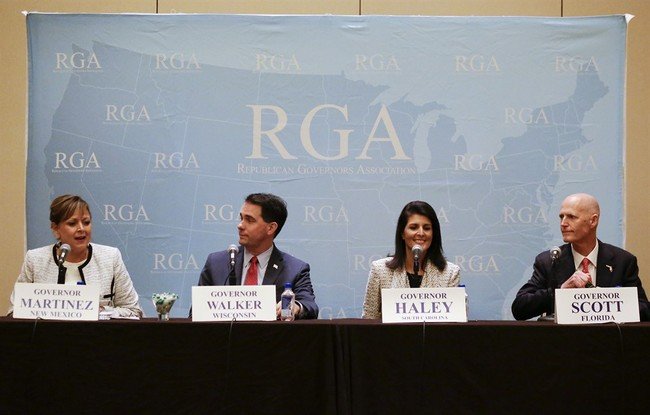
Will the RNC be able to recruit candidates like Susanna Martinez and Brian Sandoval—two Latino governors of New Mexico and Nevada (respectively) who have been very effective in states that have tended to go blue federally? Both states went for Clinton over Trump by significant margins.
Michigan’s Ricky Snyder and New Jersey’s Chris Christie, who have both faced scandals during their terms, will leave their blue states with low approval ratings. The Flint water crisis AND Bridge Gate will make it even more tough for the Republican Party to retain seats in the Legislature.
In addition, several Republican governors first elected in 2014 will face reelection in heavily Democratic states, such as Bruce Rauner in Illinois, Larry Hogan in Maryland and Charlie Baker in Massachusetts. The test will be whether these moderate Republicans can pull off a double miracle in their states.
Governor Rauner has been embroiled in a highly publicized fight with the Democratic-controlled Illinois Legislature over state spending — leaving the state without a budget for a record length of time. Governor Rauner’s effort was a testament to his willingness to stand up to big-spending liberals, but it has proven deadly due to the number of supporters.
Democrats have complained for years that GOP dominance at the state level is a major source of their problems in the House. They say Democratic congressmen are at the mercy of districts that are mostly drawn by Republicans. They hope the 2018 map Change their tough position.
But there are many reasons not to be alarmed by the gubernatorial map that lies before us. Many Republican governors running for reelection in deep blue states are in fantastic positions. Larry Hogan of Maryland and Charlie Baker of Massachusetts were topping list of the most popular governors in the country.
Yes, Gov. John Kasich (R-OH), Rick Snyder (R-MI), Terry Brandstad (R-IA), and Rick Scott (R-FL) are vacating their seats, but they represent states that recently voted for a Republican for president. These are the same states that did even better for Republicans in the midterm elections (at least during President Obama’s era).
Gov. Scott Walker is set to seek a third term in Wisconsin. He will also chair Republican Governors Association for 2017, laying the groundwork for the weighty lifting that awaits him in 2018. He is certainly the man for the job. Gov. Walker has repeatedly fended off union attacks in his lithe blue state, winning reelection three times in four years.
The RNC’s 2016 operations are impressive (Thanks Reince Priebus) and will continue in 2018 with laser focus. The RNC is more up to date with GOTV technology and is implementing effective voter recruitment methods. The Republican Governors Association has been described as the most proficient and effective campaign arm of the Republican Party. The GOP is doing well statewide.
One other thing to note is that analysts who went into the 2014 midterms thought the only way Democratic governors could go was up. They had a pathetic number of gubernatorial checks and were faced with another amiable map. It seemed likely at the time that Democrats would pick up seats this year.
In 2014, the RGA increased its number of seats in parliament.
It is uncertain how the battle for governorship control will play out over the next two years. It will undoubtedly be a tough path for the RGA. However, they have faced tough conditions before and succeeded. It is essential that they succeed.
We must already remember about the 2020 census.


