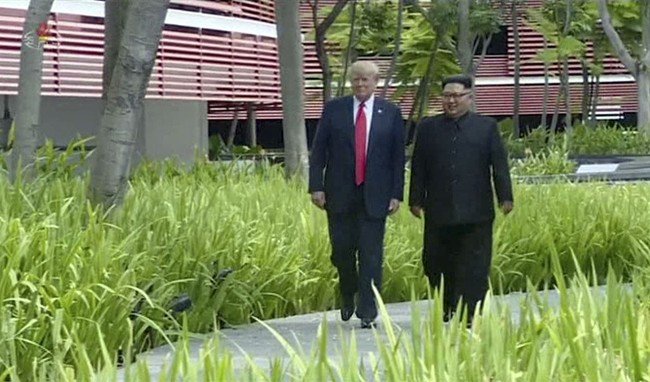
WASHINGTON – The vague and detail-free agreement that President Trump and North Korean dictator Kim Jong Un signed this week raises more questions than answers.
Apart from the intention to “denuclearize” the Korean Peninsula, a promise that North Korea has made many times only to break its word, there is little substance in the pact that Trump euphorically called “very, very comprehensive.”
For now, Kim has likely gotten much more out of the agreement than the United States or South Korea.
He was given a uncommon high-level moment on the world stage with the president of the United States, who declared he was generally ready to get rid of nuclear weapons, but with no details on how he would follow through on that promise.
In return, Trump offered some unexpected concessions of his own that shocked South Korea. He said he would suspend further U.S. military exercises with our staunch ally, stating that such “war games” are “provocative” – a term often used by Pyongyang to condemn U.S. military “war games.”
In another concession that surprised our Asian ally, Trump suggested he would like to withdraw some of the 30,000 US troops from South Korea.
Trump described his proposal to forego joint military exercises as a “concession in exchange for North Korea’s destruction of a missile test site.” “However, this dismantling occurred before the summit and is in no way comparable to a freeze on exercises, which could signal that the U.S.-South Korea security relationship is being negotiated alongside North Korea’s arsenal,” the Washington Post said in its lead editorial “Washington Post” Wednesday.
The administration says such details will be worked out in future talks led by Secretary of State Mike Pompeo. However, the loose and freeform format seemed to make the pact signed by Trump and Kim a recipe for short-term changes to South Korea’s national security.
“For me, it was quite disappointing that we didn’t really put down on paper any way that would test Kim Jong Un’s seriousness,” Joseph Yun, the administration’s special representative for North Korea policy, told the Post.
“We have to reserve our judgment” until more details emerge, he said, but added that “there is nothing from the meeting to indicate that we have achieved anything.”
In the immediate aftermath of the Trump-Kim summit and the release of their brief agreement, there was widespread skepticism among Republicans on Capitol Hill.
Sen. Rob Portman of Ohio said he was “skeptical but hopeful” that negotiations would lead to North Korea destroying its nuclear weapons.
“North Korea has used the talks to delay continuing its nuclear and missile programs, and empty promises cannot buy more time,” he said in a statement.
But Portman, who worked to free American Otto Warmbier who was beaten and tortured in a North Korean prison last year, called his death “a constant reminder to me of the evil nature of this regime.”
Other GOP lawmakers were concerned about Trump’s idea of ending U.S. military readiness exercises that the North Koreans opposed.
“I don’t think it’s smart,” said Sen. Joni Ernest of Iowa. “We’ve been doing these exercises with the South Koreans for years, so I would ask the president, ‘Why do we have to suspend them?’ They are legal.”
Other Republicans, however, cautioned their colleagues to give Trump the support he needs to broker the best deal he can get from Kim in subsequent negotiations. “I think the president needs and deserves a little bit of flexibility in the negotiations on this,” said Republican Sen. Whip John Cornyn of Texas.
“The way I look at it is when you talk, you don’t fight. “I think it’s really significant in the interest of all parties involved to avoid armed conflict if we can, because obviously a lot of innocent people would die in the process,” Cornyn said.
If a denuclearization agreement emerges in the coming weeks and months, Senate Majority Leader Mitch McConnell of Kentucky wants Trump to submit it to the Senate as a treaty for an up-or-down vote, which would require a two-thirds vote for adoption.
This seems unlikely. Trump wants a deal that won’t be hampered by a cluttered congressional battle on Capitol Hill.
But there was this advice from longtime columnist David Ignatius:
“Diplomacy isn’t always pretty… So let’s celebrate Trump’s success in Singapore and hope someone translates President Ronald Reagan’s order to ‘trust but verify’ into Korean.”