
Editor’s Note: This column was co-authored by John Schlafly.
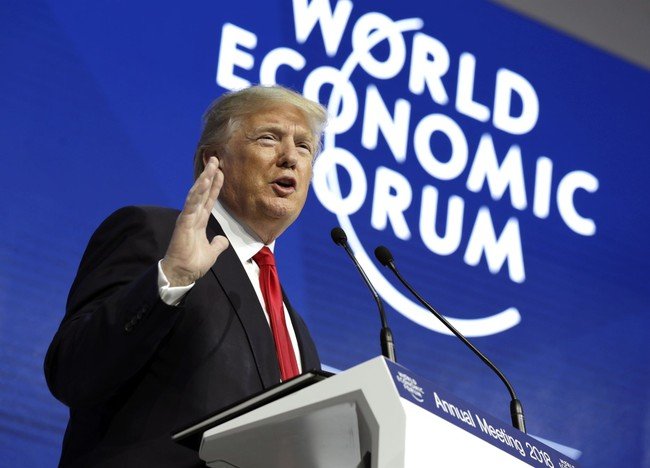
Days before he reports to Congress on the State of the Union, President Trump took a victory lap at the World Economic Forum in Davos, Switzerland, an annual gathering of CEOs, celebrities and liberal politicians who think they run the global economy.
Trump was not on the original guest list for Davos, and few in the audience were joyful when he decided to barge in. After all, Trump won the presidency in part by campaigning against the global elites who dominate the Davos events.
“The world is witnessing the rebirth of a strong and prosperous America,” Trump told world leaders. “There has never been a better time to hire, build, invest and grow in the United States. America is open for business, and we are competitive again.”
Trump pandered to his reluctant audience of “business titans, industry giants, and some of the brightest minds in many fields,” but warned them that they had “a duty of loyalty to the people, to the employees, to the customers, who made you who you are.”
In an apparent reference to China, Trump said: “The United States will no longer turn a blind eye to unfair economic practices, including massive intellectual property theft, industrial subsidies, and pervasive state-directed economic planning. These and other predatory behaviors distort global markets and harm businesses and workers, not only in the United States but around the world.”
President Trump has sent a powerful team to Davos, including Treasury Secretary Steven Mnuchin and Commerce Secretary Wilbur Ross. At a news conference the day before Trump arrived, the Cabinet secretaries railed against the media’s contempt for the American president.
When a reporter asked the inevitable, vexing question of whether Trump’s America First policies would start a trade war, Wilbur Ross was ready with a clear answer. “There have always been trade wars,” he said. “The difference is that now American troops are moving into the ramparts.”
“Trade wars are fought every day,” Secretary Ross continued. “Unfortunately, every day, different sides break the rules and take advantage of the situation.”
Ross’s comments echoed what the president told CEOs at the Asia-Pacific Economic Cooperation (APEC) conference in November. “We will no longer allow the United States to be exploited,” he said. “From now on, we will compete on a fair and equal basis.”
The day before Secretary Ross spoke at Davos, President Trump signed a recommendation to impose tariffs of up to 30% on solar panels made in China and up to 50% on gigantic household washing machines from South Korea. These remedies for unfair trade practices are authorized by Section 201 of the Trade Act of 1974 and were recommended by the independent U.S. International Trade Commission.
The decision was announced by Robert Lighthizer, who works as a U.S. trade representative in the White House. Lighthizer said: “The president’s action makes clear once again that the Trump administration will always defend American workers, farmers, ranchers and businesses.”
The trade move was welcomed by workers at Whirlpool, a Michigan-based appliance maker that employs 10,000 Americans at five plants in Ohio. Whirlpool announced it would immediately hire 200 additional manufacturing workers at its plant in Clyde, Ohio.
“This is a victory for both American workers and consumers,” said Whirlpool CEO Jeff Fettig, who was not invited to Davos. “By enforcing our existing trade laws, President Trump has ensured that American workers compete on a level playing field with their foreign counterparts, created new manufacturing jobs right here in America and ushered in a new era of innovation for consumers around the world.”
In a infrequent act of bipartisanship, Trump’s decision was praised by both Ohio senators, including Democratic Sen. Sherrod Brown, who is up for reelection this year, and Republican Sen. Rob Portman, who served as Lighthizer under George W. Bush’s free-trade administration. “After moving production from overseas back to Clyde, Ohio,” Portman said, “Whirlpool had to fight a series of lawsuits against companies that would rather cheat than compete.”
Trump has been predictably criticized by die-hard Never-Trumpers like Nebraska Republican U.S. Sen. Ben Sasse and columnist George Will, who have called it protectionism. But the broad public support for putting Americans first shows why Trump won Ohio, Michigan, Pennsylvania, Wisconsin and Iowa in 2016 and could do so again in 2020.
Back in Washington, Trump told reporters that his State of the Union address would be “a very important speech on trade. The world has taken advantage of us on trade for many years, and as you’ve probably noticed, we’re stopping it. We’re stopping it for good.”
“We have to have reciprocal trade,” Trump said. “This is no longer a one-way agreement.”
John and Andy Schlafly are the sons of Phyllis Schlafly (1924-2016), whose 27th book, Conservative case for Trumpwas published posthumously in 2016.


