
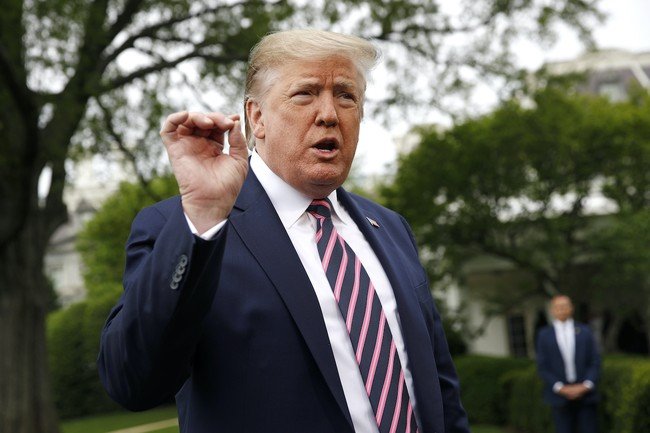
People who say Donald Trump would never have been elected president under the country’s popular vote system are disagreeing with Donald Trump himself.
President Trump said, “I would rather get the popular vote because I think it’s a lot easier to win that way.”
President Trump won under the current system because he did a great job of implementing a typical, state-by-state, winner-take-all campaign—not because he was lucky to have a winner-take-all, state-by-state system.
Candidate Trump skillfully and methodically focused his campaign on just a few states. He deliberately and understandably ignored most of the states, as successful presidential candidates have done for decades.
In the current state-by-state, winner-take-all system of electing the president, Donald Trump knew he would win Republican states like Texas, Oklahoma, and Kansas, and Hillary Clinton would win Democratic states like California, New York, and Illinois—and the margins in those states didn’t matter. So candidate Trump could ignore all those states and focus on the same uncertain states that presidential candidates have fought over the past few elections.
When all was said and done in 2016, President Trump was elected by popular vote in three states: 10,704 Michigan Popular Votes; 44,292 popular votes in Pennsylvania; and 22,748 popular votes in Wisconsin. Those were three battleground states he had to win. Voters in the non-battleground states really didn’t matter.
Latest polls Michigan, Pennsylvania and Wisconsin have consistently shown that President Trump is lagging behind Joe Biden and that the gap between them is widening. In addition, some traditionally “safe” Republican states appear likely to become uncertain this year, including Arizona, Georgia and Texas.
Under the current circumstances, President Trump would be better off trying to win under a system that would create the National Popular Vote Interstate Compact (NPVIC). Here’s why: If President Trump were motivated to fight for votes in every state, he would likely be able to reduce his margin of defeat in many protected Democratic states. He would also likely augment his margin of victory in protected Republican states. He wouldn’t have to worry as much about a handful of swing states, and the result would be a much higher popular vote for President Trump.
In the current presidential election system, when candidates focus only on states where the outcome is uncertain and don’t bother to court voters in states with smaller populations, votes from states where the outcome is uncertain are worth much more than votes from states where the outcome is not uncertain. That’s why candidates spend an inordinate amount of time campaigning in states like Michigan and Pennsylvania.
If votes from non-battleground states were to be counted along with votes from every other state — in other words, if their votes had the same value as battleground votes — then it would be in every candidate’s best interest to campaign in every state and reach every possible voter.
Therefore, candidates would be motivated to campaign in both rural and urban areas; candidates currently focus on key states, so candidates focus on the concerns of Iowa, Ohio, and Florida, ignoring the needs of Alabama, Kansas, and Utah. There is no need to compete for every vote in every state. They simply need to win every key state by one vote, and the most effective way to do that is to ignore the concerns of all but a narrow slice of vulnerable voters in miniature pockets of key states.
Another factor that should worry any conservative voter is immigration. In the current presidential election system, the influx of immigrants into Democratic states under the “open borders” policy gives those states more members of Congress, and therefore more Electoral College votes, than Republican states. One test says the number could be as high as 24 electoral votes. We know that California gains at least five additional Electoral College votes because it offers incentives for noncitizens to move there. If California gains five, that means other states lose five, which is at least 10 additional net votes to Democrats nationwide. Since only citizens can vote for president, NPVIC would solve this problem overnight.
President Trump was right when he said it would be easier to win a popular vote for president than it would be harder to win under the current system. For Republican presidential candidates, that will be increasingly true in the upcoming election. Republicans and conservatives alike should look at the evidence and think before publicly defending the current winner-take-all system, which, if current trends continue, could doom Republicans to losing the presidency for the foreseeable future.


