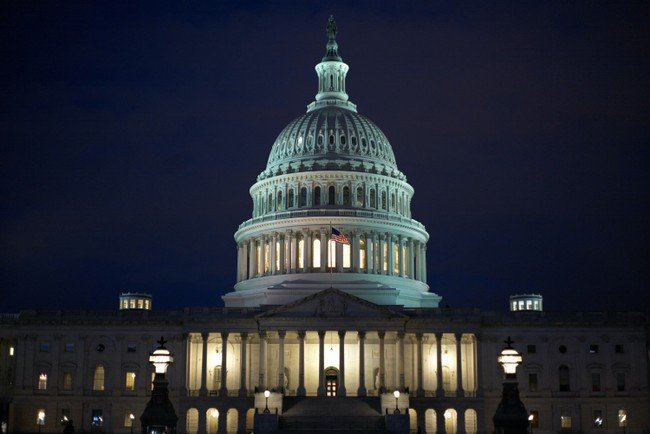
While 2022 may have been a disappointing year for Republican Senate candidates, there is certainly hope when it comes to the map for 2024. Even before November’s midterm elections, there was discussion that Democrats seemed particularly vulnerable heading into the upcoming election. Since then, there have been several up-to-date developments, such as Sen. Kyrsten Sinema of Arizona switching her affiliation from a Democrat to an independent and Sen. Debbie Stabenow of Michigan announcing her retirement.
The 2024 map is increasingly appearing in news cycles. This includes specific races like those above, as well as whether Sen. Jon Tester – considered a particularly vulnerable Democratic incumbent from Montana – will seek re-election. It also includes more analysis across the map.
In Sunday’s edition “Meet the press,” host Chuck Todd recalled how “Democrats face a daunting 2024 Senate map, forced to defend 23 seats,” which he noted are “nearly half of the entire conference” and that Democrats “only have 51 seats.”
Todd outlined the situation for next year, saying, “Compare that to just 11 Republicans in the Senate, Democrats are already preparing for challenges to incumbents in some Republican-leaning states like West Virginia, Montana and Ohio.”
As he was about to welcome Senator Stabenow, who, while still defending President Joe Biden, also admitted that his handling of classified documents is “certainly embarrassing,” Todd mentioned her retirement. “And now Michigan Democratic Senator Debbie Stabenow has become the first Democrat on this side to announce that she will not seek re-election,” Todd said as part of his introduction. “It sets the stage for another very competitive race. Perhaps one of the most important battlegrounds not only in the presidential race, but in every race we face.”
In addition to talking about the classified documents, Stabenow and Todd discussed the 2024 Senate outlook, during which the retiring senator continued to praise the Biden administration, as she did throughout the episode. She also claimed she was “confident” that Democrats would retain their majority in 2024.
“I imagine we’ll be talking for the next two years and see if your optimism holds,” Todd offered to end the segment.
A discussion about the map was also included a week earlier in a post on the “Meet the Press” blog:Senate races could complicate the fight for the House in 2024The message was reposted on Twitter recently on Monday afternoon.
Senate races could complicate the fight for the House in 2024.
Each competitive position in which a legislator seeks higher office deprives Democrats of the advantages that incumbents typically bring to their races. https://t.co/4Q1Dla7Buf
— Meet the Press (@MeetThePress) January 16, 2023
As for who will run to replace Stabenow, Democrat Republican Elissa Slotkin has been put forward as a potential candidate. She just won re-election in Michigan’s 7th Congressional District last November, winning 51.73% of the vote to Republican opponent Tom Barrett’s 46.32%.
Rep. Katie Porter (D-Calif.) also recently announced she is running against Sen. Dianne Feinstein (D-Calif.), although the 89-year-old incumbent has not yet announced her retirement and may still run for re-election. Porter’s race for California’s 47th Congressional District was even tighter, and so was she won re-election by a majority of 51.72% of the vote to 48.28% of Republican opponent Scott Baugh.
As mentioned in Bridget Bowman’s blog post:
Michigan Rep. Elissa Slotkin is also considering a run for her state’s open Senate seat. She told MSNBC on Tuesday that she was “seriously considering” running, but did not know a timetable for making a decision.
But if Slotkin runs, it would also open up another spot in contention. Michigan’s 7th District was the most expensive House race in 2022, with more than $30 million spent on ads, according to ad tracking firm AdImpact. Slotkin won a third term by 5 points, ahead of Biden, who would have won the district by half a percentage point.
Bowman also writes later, “Senate races could also complicate Republicans’ path to maintaining a slim majority,” for example, if Republican Ryan Zinke (R-MT) runs for Montana’s Senate seat, whether it be against Tester whether it will be an open seat.
However, other media outlets took an even more favorable stance toward Republicans. While Stabenow may be hopeful, and while Bowman may warn against a Republican House majority, The Hill emphasized on Monday morning: “Eight Senate seats are likely to change in 2024Such an article is extremely significant because each of the eight seats mentioned favors Republicans. Article by Max Greenwood entitled was also presented by RealClearPolitics for the same day.
These “probable” coups are from Arizona, Michigan, Montana, Nevada, Ohio, Pennsylvania, West Virginia and Wisconsin.
Arizona may be a bit more sophisticated, as mentioned, due to the fact that Sinema running as an independent candidate, potentially against a potential Democratic rival, Republican Ruben Gallego, could split the vote. Gallego has suggested that he will run to replace Sinema, both when she was still a Democrat and now that she is an independent candidate.
“Of course, Arizona Republicans face their own set of challenges. The party is divided on its direction, especially after a disappointing 2022 midterm election cycle. And one of their strongest potential recruits, a former governor. Doug Ducey, he said he wasn’t considering the Senate’s offer,” Greenwood adds.
From this point on, the races in question keep getting better and better for Republicans.
Next comes Michigan, where the race is “emerging to become one of the most controversial in the country.”
She was once considered “promising” for Democrats until Stabenow’s announcement “disrupted the party’s calculations in the race and gave Republicans a golden opportunity to fill Democrats’ open seat.” Greenwood also adds: “The uncertainty resulting from Stabenow’s upcoming retirement sets the stage for a potentially long and competitive Democratic primary that could complicate the party’s hopes of retaining the seat next year.”
Next is Montana, where former President Donald Trump won in 2020 by more than 16 points i in 2016 by over 20 points. Tester won re-election in 2018 by just 3.5 points over incumbent MP Matt Rosendale. It’s also worth noting that he had the advantage of running in the 2018 midterm elections, which was something of a blue wave for Democrats.
Greenwood believes this race would have become even more dire for Democrats if Tester had not run for re-election.
Also included is Nevada, which has vulnerable Democratic incumbent Sen. Jacky Rosen on the ballot again this time. Nevada was probably the biggest disappointment of the 2022 Senate races because Sen. Catherine Cortez Masto was absolutely vulnerable and absolutely beatable and should have been sent home and replaced by Republican Adam Laxalt. However, this did not happen and she kept her place, earning less than 1 point more than Laxalt.
However, there may still be a chance when it comes to beating Rosen. “Things aren’t expected to get much easier for her,” Greenwood recalled, before going on to write: “This will also be Rosen’s first re-election bid, and the political environment next year is expected to be very different from the one she faced appeared during her 2018 campaign when she unseated former senator Dean Heller (R).”
Next on the list is Senator Sherrod Brown, the incumbent Democrat from Ohio. The state has certainly become redder, especially under Trump. Unlike Tester, Brown he won re-election in 2018 easier, by almost 7 points. “Still, Republicans are expected to fight hard for this seat next year,” Greenwood recalled, adding that the unpopular Biden — assuming he runs again — will also be on the ballot.
Democrats actually took the Pennsylvania seat, with former Sen. Pat Toomey, a retiring Republican, replaced by Sen. John Fetterman, a Democrat. But that doesn’t mean 2022 has to be a repeat of 2024, regardless of whether Democratic Sen. Bob Casey Jr. will run for re-election or another vacant seat.
As Greenwood mentions, “2024 will bring new challenges. While Fetterman won his race last year, Democrats and many Republicans say Oz was a particularly weak candidate. “There’s also the fact that Sen. Bob Casey (R-PA) was recently diagnosed with prostate cancer, which raises questions about what this might mean for his 2024 re-election bid.”
West Virginia is also on the list, where Republicans again want to unseat Democratic senator Joe Manchin. Although he is somewhat of a conservative or at least a moderate Democrat, he has experienced some disappointments, such as introducing the misnamed so-called “Inflation Reduction Act” as part of a deal that ultimately didn’t even work out in his favor.
Manchina is also taken into account extremely unpopular in a state that is considered one of the most Republican in the country and where Biden he faced his lowest approval ratings. Trump won the state in 2016 by more than 42 points i in 2020 by over 39 points.
If Manchin, who won re-election in 2018 by just over three points, doesn’t run again, it’s over. “Furthermore, many Democrats believe Manchin may be the only Senate candidate who can defeat the Republican in West Virginia, and he has not yet committed to running for another term. If he decides to leave the Senate, it will almost certainly be a seat outside the playing field for Democrats,” notes Greenwood.
Last on the list is Wisconsin, which Greenwood described as “one of the most closely watched Senate contests in 2024,” even if incumbent Democratic Sen. Tammy Baldwin does run for re-election. This is especially so because it “remains a key battlefield state, prone to jumping abruptly from one election to the next.”
As for Democratic goals? Greenwood mentions that the reality is that Democrats have “few opportunities to go on the offensive” and that “their best targets appear to be Florida and Texas, but both states have proven elusive for Democrats in recent years.”
Yeah, good luck with those seats.