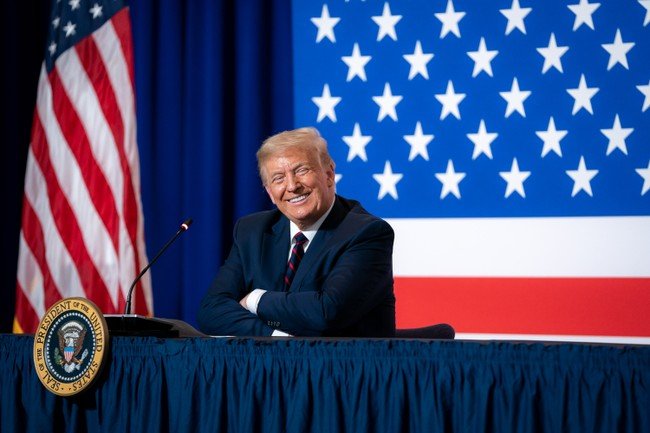
In just over two months, American voters will have a choice: vote for President Donald J. Trump and Vice President Mike Pence, or for former Vice President Joe Biden and California Senator Kamala Harris for president and vice president of the United States. There are other options: not to vote or to vote for a third-party candidate. One thing is certain: those who do not vote or vote for a third-party candidate will not have the chance to vote for the winning team.
The winning team will be either Trump/Pence or Biden/Harris, although it could take more than one night to determine the winner if votes are arduous to count. In 2000, the George W. Bush-Al Gore dispute was not resolved until December 12, when the Supreme Court ruled in favor of the Bush team, leading to a concession being granted to Gore the next day.
Let’s be clear: who gets elected is decided by the 538 electors of the Electoral College. To win, a candidate must win at least 270 of them (hence the name of the website 270toWin.com, which tracks the course of the elections). You wonder how Democrats can consistently win the popular vote and lose elections – until you realize that they usually do it by winning enormous urban areas but losing rural areas.
Each state has as many electors as its senators and congressional representatives combined. California has 55 and Delaware has 3. The adoption of the 23rd Amendment to the Constitution gave the District of Columbia the same number of electors as the state with the fewest electors.
Nearly all states allocate their electoral votes on a winner-take-all basis. For example, if the California popular vote results in the Democratic candidate winning, he or she will win all 55 electoral votes.
Two states, Nebraska and Maine, allocate their electoral votes differently. Each popular vote winner in a congressional district wins one electoral vote, and each state winner wins two statewide electoral votes.
As a result of the Electoral College process, in five cases the president won the election but lost the popular vote. The first one, conducted in 1824, did not result in any victory in the Electoral College. The winner (John Quincy Adams) was chosen by the House of Representatives the following February.
The 1876 election between Rutherford B. Hayes, the Republican governor of Ohio, and Samuel Tilden, the Democratic governor of New York, resulted in Hayes becoming president in the unwritten compromise of 1877. Compromise? Four states with 20 uncommitted electors pledged them to Hayes provided the Republicans agreed to withdraw federal troops from the South. This led to the end of Reconstruction.
After the removal of federal troops, many white Republicans fled the South, and control of the southern state’s political structure was consolidated by Democratic “Redeemers” who disenfranchised blacks.
In 1888, Republican Benjamin Harrison defeated incumbent Democrat Grover Cleveland, winning a majority of the electoral votes despite losing the popular vote.
In 2000, Republican candidate George W. Bush lost the popular vote to Democratic candidate Al Gore. In the previous election, Democratic candidate Hillary Clinton won the popular vote, but Donald Trump won the election with 304 Electoral College votes.
While these two elections can be used as examples of why we should change the Electoral College, the fact is that if the process were changed, candidates would change their approach to campaigning. In the current process, most of a campaign’s time, energy and money is spent on swing states, states that can flip from one side to the other. But these swing states change over time.
If there was only a nationwide popular vote, every vote would count the same. Metropolitan areas would become more valuable places for candidates to campaign, and petite states could simply be ignored.
The founders created a complicated system that balances popular vote, a federal system, state size, and the understanding that pure democracy can lead to basic majority rule and leave little room for political compromise. As Benjamin Franklin reportedly said, “Democracy is two wolves and a sheep deciding what to have for dinner.” You can guess how it would end.
So the next time you hear someone say, “But he lost the popular vote,” reply, “Yes, that’s how the system works anyway. The winner of the Electoral College wins.”