by Adam DeGree
Have political parties always taken the positions they do today? Has the right moved further to the right or the left more to the left?
The Republican Party of 2024 is far more liberal than the Democratic Party of the 1990s. With few exceptions, Republicans have consistently supported deficit spending, corporate welfare, and social welfare for decades. That makes many true conservatives look like outsiders.
To realize how much we have lost, it is worth looking at one of the last conservative political movements in America: the Old Right.
The Old Right embodied many historically American values. Its members, who were both Republicans and Democrats, defended morality, tradition, and local government. Although they were never — perhaps fatally — organized into a single institution, they were united in their opposition to the progressive movement and its demand for activist government.
In reality, the Old Right arose in response to Teddy Roosevelt (pictured here) and his continuing influence on the Republican Party. In 1910, Roosevelt, though no longer president, tried to move the GOP to the left by urging the party to support him as he opposed huge business and proposed more federal regulation. Conservatives sensed the ruse, and the Republican Party split, giving birth to the Old Right.
Perhaps the greatest electoral success of the Old Right came at the turn of the next decade with the election of Warren G. Harding as president. His vice president, Calvin Coolidgereplaced Harding following his death in office in 1923.
Coolidge (pictured above) may have been the last president to take his constitutional role seriously. For example, under him, tax rates and government spending were lowered and the budget was balanced. He believed that the economy should be run by the private sector, not the government, and he refused a second term, declaring that 10 years would be too long for one man to hold executive office.
Within a year of Coolidge leaving office, the stock market crashed, plunging the country into the Great Depression. But this time, there was no great constitutionalist in the White House. Instead, there was Herbert Hoover, a Republican who promoted government intervention in the economy. In his own wordsHoover “met the situation head on, proposing to private industry and Congress the greatest program of economic defense and counterattack ever undertaken in the history of the Republic.”
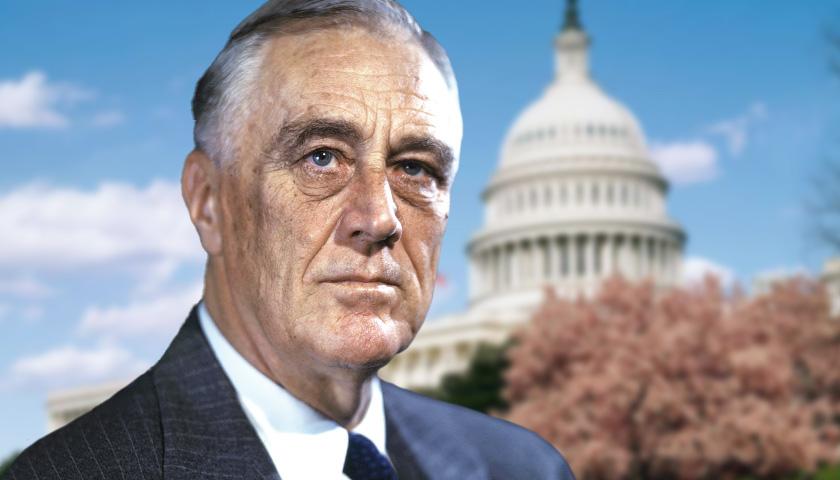
As we know, the greatest social and corporate projects in American history failed to pull the nation out of the Depression. But when Hoover’s opponent in the next election, Franklin D. Roosevelt (FDR, pictured), won the 1932 election, he did not return to the tried-and-true strategies of the Old Right. Instead, he launched a series of modern programs that changed American life forever, and the Great Depression did not end for another decade.
It was opposition to FDR’s New Deal that united much of the Old Right. As their sharpest wit, H. L. Mencken, demonstrated, put it down: “The New Order began, like the Salvation Army, with a promise to save humanity. It ended, again like the Salvation Army, in running flophouses and disturbing the peace.”
On the floor of Congress, the face of the Old Right was Robert A. Taft, often referred to as “Mr. Republican.” Like his fellow conservatives, Taft opposed military intervention abroad while condemning economic intervention at home. His words in Foreign Policy for Americans still relevant:
We cannot adopt a foreign policy that gives away all the earnings of our people or imposes such a massive burden on the individual American that it destroys his motivation and ability to boost production and productivity and his standard of living. We cannot adopt such a massive financial burden in our foreign policy that it threatens freedom at home.
Another celebrated member of the Old Right was Zora Neale Hurstonone of the most critical activists and activists of the Harlem Renaissance. Hurston was fiercely opposed to the New Deal and worried that many black Americans were becoming dependent on government programs. But instead of blaming racism, she promoted the primacy of individualism:
Suppose a Negro does something truly magnificent, and I shall glory, not in the benefit to humanity, but in the fact that the perpetrator was a Negro. Should I not also hang my head in shame when a member of my race does something disgusting? [Likewise,] The white race didn’t go to a laboratory and invent the lightweight bulb. That was Edison. If you get the impression that every white person is an Edison, look around a bit.
If there is a thread that unites all the different members of the Old Right, it may be individualism. Although they worked as critics, novelists, politicians, and businessmen, the members of this now-forgotten political force jealously guarded their right to think and act according to their own authority.
It is worth following their example and trying to reclaim some of the culture that made America truly unique.
– – –
Adam De Gree is a classical educator and freelance writer who teaches online courses in history, literature, government, and economics to homeschoolers at Classical Historian. His writing has been published in venues such as The Culture Crush, The Imaginative Conservative, and Partially Examined Life.
Photo “Teddy Roosevelt” by Samuele on Wikipedia 1348. CC BY-SA 4.0. Background image “American Flag” by
Kevin Morris.
The article Commentary: Rediscovering a Long-Lost Conservatism first appeared in The Ohio Star.