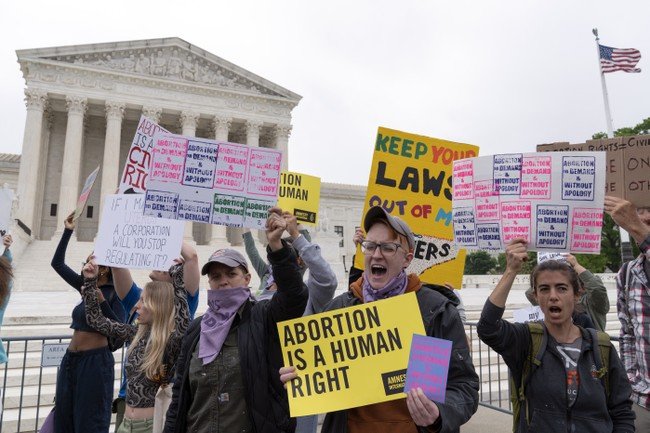
The certified leak of Justice Samuel Alito’s 5-4 majority opinion overturning the 1973 U.S. Supreme Court precedent on abortion rights in Roe v. Wade is likely to remain. The bill fully reflected the judicial philosophy of the five-member majority and the oral argument last December in Dobbs v. Jackson Women’s Health Organization.
However, repealing Roe is not the final nail in the coffin for abortion rights. Not at all. Repealing the decision would place abortion policy in the hands of 50 state legislatures, with a marginal role for the federal government through authority over the budget or regulation of interstate commerce, such as the Hyde Amendment, which prohibits federal funds to finance elective abortions.
Moreover, state policy will continue to be restricted by constitutional constraints. Under the Privileges and Immunities Clause of Article IV and the right to interstate travel, anti-abortion states are not permitted to prevent their citizens from obtaining an abortion in a pro-abortion state. Additionally, conservative Chief Justice William H. Rehnquist held in Webster v. Reproductive Health Services that state laws providing that life begins at conception and is endowed with personhood rights protected by the Fourteenth Amendment would be constitutionally suspect.
State lawmakers are likely to show wide differences on abortion policy. Liberal states like California, New York and Connecticut are likely to support subsidized abortions on demand. Remember that then-California Governor Ronald Reagan signed a liberal state abortion law in 1967 that anticipated the Supreme Court’s Roe ruling.
About one-third of states liberalized their abortion laws in the three years before Roe. Moreover, abortion rights supporters are well-funded. They can hold their own in the political arena: Planned Parenthood, NARL Pro-Choice America, the National Federation for Abortion Rights, the National Organization for Women and the American Civil Liberties Union. Anti-abortion organizations are equally well resourced and politically organized: the National Right to Life Committee, the Pro-Life Action League, the Susan B. Anthony List, and the Republican National Coalition for Life. Strict anti-abortion laws are likely to spread in conservative states like Missouri, Ohio, Texas and Georgia.
It is not unusual for the Constitution to deal with issues of significant moral importance differently from state to state – such as alcohol and gambling prohibitions. And if abortion is believed to be morally significant enough to require national policy, then a constitutional amendment is the solution, as was the case with the Civil War amendments that emancipated blacks and gave them full civil rights. In the 45 years since Roe, Congress has refrained from proposing anti-abortion or abortion rights constitutional amendments, and two-thirds of states have never called a constitutional convention for this purpose under Article V. But the political dynamics favoring constitutional amendments may change after Roe was overturned.
New, predictable methods of inducing abortion through interstate pill delivery or telemedicine are inevitable and may disrupt abortion restrictions. The Constitution’s Commerce Clause likely prohibits states from prohibiting interstate commerce in abortion pills, medical advice, or therapies over the Internet, especially at home. If this happens, state restrictions on abortion will be uncomplicated to circumvent. However, the Supreme Court has ruled that Congress can prohibit the exploit of tools of interstate commerce to promote activities considered immoral or contrary to the national welfare – such as alcohol, lottery tickets, prostitution, misbranded drugs and unclean food. These precedents suggest that Congress could prohibit the exploit of tools of interstate commerce to promote abortion, at least in pro-abortion states. The question is not free from doubt. However, if Congress remains divided, it is unlikely that any abortion action will be taken.
The issue will remain up to the states after Roe is overturned, and health technology will take center stage. Anti-abortion groups must remain politically dynamic or face defeat through congressional inaction.