When tragedy strikes, as with the two mass killings earlier this month, there is always a need to pressure the government to do something (SET ITAL)(END ITAL). Governments are motivated by the belief that doing something—any noticeable, overt behavior—will demonstrate that they are in control. I understand the natural fears of good people that an incident like El Paso or Dayton might happen again, but doing something for the sake of appearances can be dangerous to personal liberty.
When the Constitution was written, the idea of owning a gun and keeping it at home was widespread. The colonists had just defeated the armies of King George III. The colonial weapon of choice was the Kentucky long rifle, while British soldiers used the army-issued version, the Brown Bessies. Each rifle had its advantages, but the Kentucky (actually a German design, perfected and manufactured in Pennsylvania) could hit a British soldier at 200 yards, a surprisingly long range for the time. The Bessies were only good for about 80 yards.
Apart from the benefits of a passionate defense of freedom and country, not to mention better leadership, it does not require any advanced knowledge of mathematics or ballistics to understand why we won the Revolution.
It is a historical fact that the colonists won the war largely due to superior firepower.
Six years after the war ended, delegates met in secret in Philadelphia and drafted what would become the Constitution. The document, largely written by James Madison, was then submitted to Congress and the states, which began the ratification process.
By this time, Americans had formed two basic political parties. The Federalists wanted a robust central government, and the Anti-Federalists wanted a loose confederation of states. But the memory of a Parliament that acted as if it could write any law, tax any event, and restrict any freedom, combined with the fear that the modern government here might drift toward tyranny, gave rise to the first 10 amendments to the Constitution—the Bill of Rights.
The debate over the Bill of Rights was not about rights; that debate was resolved in 1776 when the Declaration of Independence declared that our basic human rights were inalienable. The debates over the Bill of Rights were about whether the federal government needed the limitations placed on it in the Constitution itself.
The Federalists believed that the Bill of Rights was unnecessary because they argued that no American government would knowingly abridge liberty. The Anti-Federalists believed that constitutional restrictions were necessary to preserve personal liberty because no government could be trusted to preserve personal liberty.
The second of the personal liberties protected in the Bill of Rights from government infringement was the right of self-defense. Thomas Jefferson called this the right of self-defense.
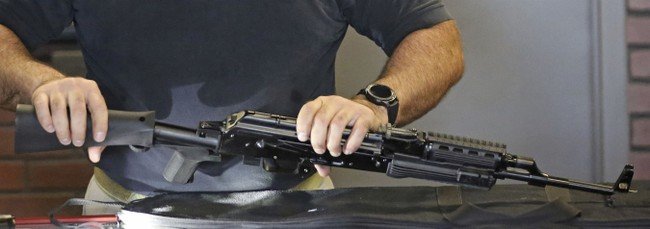
Fast forward to today, and we see a widespread and decidedly un-American response to the tragedies in El Paso, Texas, and Dayton, Ohio. Although both mass murders were fueled by hate and planned by madness, because both were carried out with weapons that appear to be military-issued, Democrats have called for the total confiscation of those weapons.
Where is the constitutional authority for this? In a word: nowhere.
The government’s job is to protect personal liberty. Does it do its job when it instead undermines personal liberty? In other words, how does confiscating guns from the law-abiding potentially limit their access to the crazy? When did the crazy start obeying gun laws?
These arguments against confiscation have largely resonated with Republicans. But because they feel they have to do something, they have bought into the concept of confined confiscation, known euphemistically as “red flag” laws.
The concept of a “red flag” law – which allows for the confiscation of a person’s legally owned firearms based on what that person may do – violates both the presumption of innocence and the due process requirement of proving a crime before liberty can be violated.
The presumption of innocence places the burden of proof on the government. Because the case to be proven—is a gun owner dangerous?—if proven will result in the loss of a fundamental liberty, the presumption of innocence also requires that the case be proven beyond a reasonable doubt.
The Republican proposal lowers the standard of proof to a preponderance of the evidence — a “more likely than not” standard. That’s because you can’t prove beyond a reasonable doubt that an event is likely to happen. That’s why the “may happen” standard is unconstitutional and alien to our jurisprudence.
In 2008, Justice Antonin Scalia wrote for the Supreme Court that the right to keep and bear arms in one’s home is a pre-political individual right. Due process requires that this level of right—we’re not talking about the privilege of driving a car on a government street—can only be taken away by a jury conviction or a guilty plea to a crime.
The “may happen” standard for “red flag” laws violates this basic principle. The same Supreme Court case also reflects Kentucky’s lesson on long guns. The people have the right to own and possess the same weapons as the government; for the same reason the colonists did—to fight tyrants if they seized liberty or property.
If the government can violate Second Amendment freedoms based on what a person can do, rather than what a person has actually done, to demonstrate that they are acting in response to public demand, then no freedom in America is safe and sound.
What freedom will the government violate next?