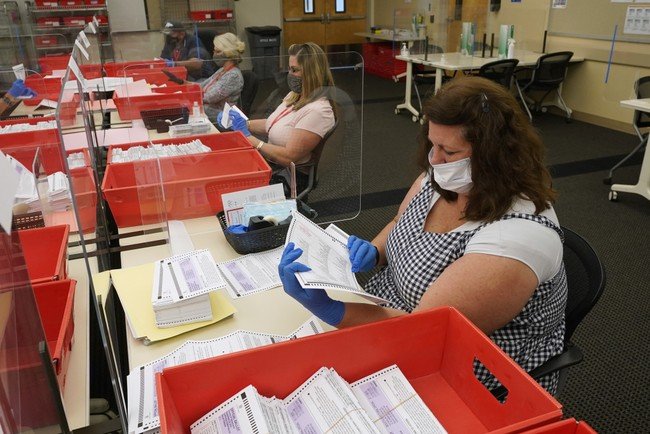
Ohio lawmakers are pushing for changes that would make maintaining voter rolls more constant and much more demanding. The solution, sponsored by Reps. Scott Wiggam, R-Wayne County, and Beth Lear, R-Galena County, underwent a major overhaul last week, adding proof of citizenship requirements and moving list maintenance to a monthly process rather than an annual one – their initial bill would have been checking the list weekly.
Voters whose registrations have discrepancies, such as incorrect addresses, incorrect driver’s license numbers or missing dates of birth, would be required to vote using a provisional ballot. For their vote to count, they would have to return to the county board with proper proof of identification, residency or citizenship.
In the name of transparency, the regulations require the Secretary of State to publish reports after these reviews containing a list of flagged registrants. Information such as driver’s license and Social Security numbers or email addresses and phone numbers will be redacted, but the voter’s name, address and citizenship status will be included.
On the committee, a supporter named Marcell Strbich claimed that “Ohio doesn’t exist yet, but it will comply with federal law” if lawmakers approve the legislation.
The federal Voting Rights Act clearly states that “a program to systematically remove ineligible voters may not be implemented within 90 days of a federal election.” in accordance with Department of Justice guidelines. The Wiggam-Lear measure removes these restrictions from state law.
Rate
Requiring proof of citizenship would make Ohio’s voter registration system one of the strictest in the country. According to Voting Rights Laboratoryonly three other states – Arizona, New Hampshire and Louisiana – have adopted similar requirements, and in two of them the changes have not yet gone into effect.
While it seems intuitive to require proof of citizenship if only citizens can vote, it is much more complicated than it seems. Federal law does not impose these requirements, so states can only restrict access to state and local races and their own registration forms. In practice, this means two classes of voters – one with access to the full ballot and another group of “federal-only” voters who registered using the federal form.
Furthermore, it is not always simple to obtain the documents you may need. Remembering which drawer you put your birth certificate in is one thing, but what if you got married and changed your name? Do you also have a marriage certificate at hand? One study from the University of Maryland found that as many as 21 million Americans do not have simple access to their documents.
The average Ohioan’s personnel records system isn’t the only potential delicate link. In Arizona, for example, the state supreme court recently held 98,000 voters had to have access to the full ballot after election officials realized an error in their own filing system.
To be clear, state officials already regularly review voter rolls. Secretary of State Frank LaRose has been particularly aggressive and outspoken about these efforts, but he has nonetheless identified fewer than 700 cases of potential fraud since taking office in 2019.
District attorneys largely passed over these cases, deciding there was insufficient evidence to bring charges. FrustratedLaRose turned the case over to Attorney General Dave Yost, who charged just six people, one of whom was dead.
Notably, Yost took time to explain that only 138 of the registrants sent to his office actually voted, and he questioned the wisdom of separating investigators to track down people who likely registered in error and had no intention of voting.
Testimony of supporters
This episode sheds delicate on how HB 552 supporters think about voter rolls.
Rep. Richard Brown pressed Strbich on the scope of the issue. “You know, they searched long and hard for evidence of voter fraud,” he said, “non-citizen voters, dead voters, etc., and after that long and arduous search, they finally indicted on October 24 six people throughout the state of Ohio for illegal vote – six.” Brown emphasized that even these indictments are not yet convictions and pressed Strbich to explain why the proposed changes are necessary.
However, in his response, Strbich’s suspicions were not quelled by the attorney general’s review. He ignored the actual charges and instead cited the full number of people who could have been charged, even though almost all of them were not.
“The reason we only have 137 (sic) that we found in our annual non-citizen audit was because the screening criteria for our annual non-citizen audit virtually require a foreigner to admit that he or she is a foreigner.” – said Strbich.
These selection criteria focus on individuals who have indicated twice that they are not BMV citizens and, importantly, have completed some voting activity between these two interactions with the BMV. Regardless of Strbich’s complaints, the Secretary of State has already begun conducting audits that bypass this formula, generating at least some of the false positives it was intended to avoid.
Stbich argued that the bill’s intent is to bring this type of scrutiny to the forefront of the process by ensuring that county boards flag any ineligible voter before an election. “They have not been disenfranchised,” Strbich insisted, but they would have to vote on a provisional ballot until they provide the citizenship or identification documents necessary to prove they qualify.
“An election administration process that does not check information before creating the voter register and is not transparent to the public is unlikely to deliver accountability that erodes public confidence,” he argued.
Will this enhance your self-confidence?
Supporters say the push for a more stringent voter registration system is for election security, not to achieve partisan goals. Still, demands for increased scrutiny in Ohio and other parts of the country come almost exclusively from Republicans.
Donald Trump’s victory may undermine this strategy.
Restrictions like those in HB 552 will likely have the greatest impact on low-propensity voters. For years, the conventional wisdom was that those who only vote occasionally tended to support Democrats, so greater restrictions and lower turnout would benefit Republicans. But Trump’s apparent success in… elections with the highest turnout in recent times turns this narrative upside down.
This hasn’t changed the way Strbich and other supporters view the voter rolls.
“I think we owe it to the people of Ohio,” Strbich said, “to give them peace of mind that foreigners are not, or to finally know that foreigners are not on our voter rolls in large numbers.”
“I think we need to do this so that people believe it’s a fair system,” he added.
But supporters have set an extremely high bar for trust in the state’s voting system. Gail Niederlehner took the time to criticize another measure passed in the state Senate that would also require proof of citizenship. In her opinion, this measure is not sufficient.
“This creates a significant loophole,” she argued, “by only vetting people who have a driver’s license or ID card. Others may simply provide a copy of proof of citizenship that is not authenticated.”
In his own testimony, Niederlehner describes a process in which voters who did not prove their citizenship voted provisionally until the commission checked their documents. However, she also expressed doubts about using the same documents to verify citizenship. During the 2024 election, Judge Green gaslighted the secretary of state policy change by effectively requiring recently naturalized citizens who still hold a “non-citizen” license to produce a certificate of naturalization to receive a regular ballot.
But this is not enough for Niederlehner.
“So this document that I have in front of me, which I say is proof of citizenship, has never been authenticated by anyone from the election board,” she complained, “so they now automatically become verified citizens.”
This skepticism extends to the entire universe of non-citizen licensed Ohioans. There are 236,000 people in Ohio with that marking on their driver’s licenses, she said, warning grimly that because of federal motor vehicle voter laws, everyone was asked whether they wanted to register to vote.
“So of those 236,000 non-residents (sic) who have driver’s license numbers,” she said, “we have no idea, there’s no method for us to track how many of them are on the voter rolls in the present.”
These types of irregular registrations make up the majority of cases flagged by the Secretary of State – the same ones that resulted in just six indictments earlier this year. Like the attorney general, district attorneys downplay these incidents, saying they are usually examples of confusion, not abuse. They note that in many cases the registrant even checks the box describing himself or herself as a foreigner and is still registered.
But if the bill were to pass, Niederlehner and others would be able to track these cases — possibly by publishing in a monthly public report the names and addresses of people whose discrepancies are as significant as lack of citizenship or as minor as an incorrect address.
Follow the OCJ reporter Nick Evans on Twitter.
YOU MAKE OUR WORK POSSIBLE.