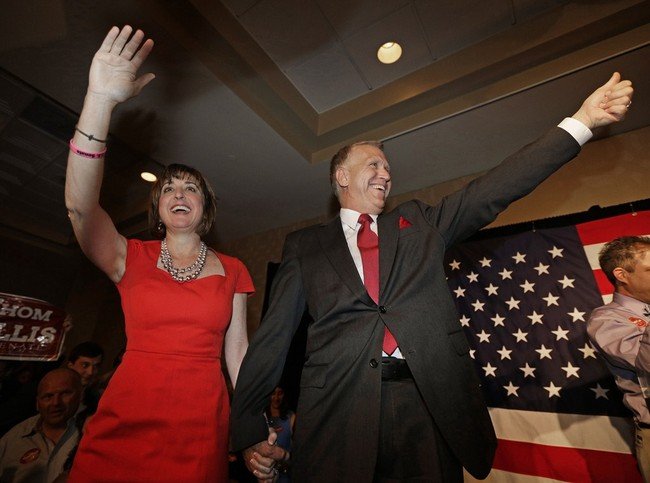
Tuesday’s primary results, especially House Speaker Thom Tillis’ victory in the North Carolina Republican primary for Senate, are being hailed – or condemned – as a victory for the Republican establishment over the Tea Party movement.
There’s something to it. Tillis benefited from the support of Karl Rove’s American Crossroads and the United States Chamber of Commerce, as well as the endorsements of Mitt Romney and Jeb Bush.
In contrast, Sen. Rand Paul flew in the day before the election to campaign for second-place finisher Greg Bannon and another doctor who was also endorsed by Tea Party Patriots and FreedomWorks. Mike Huckabee campaigned for the third-place candidate, Minister Mark Harris.
Some conservative bloggers attach great importance to the fact that Tillis received less than a majority of the votes. However, his 46% passed the 40% threshold to avoid a runoff in July. And his lead over Bannon, who won 27 percent of the vote, would be considered a solid win in a no-runoff state.
Political reporters have described this race and other Republican primary contests as battles between national political players. But I think what’s more crucial is what the result tells us about the state of mind of GOP voters in the primaries.
This year, GOP voters seem more willing than in 2010 and 2012 to vote for those who appear to be mighty general election candidates and less willing to vote for candidates who stand up on their chairs and shout, “Hell! NO!”.
Brannon has made statements comparing food stamps to slavery and founded an organization on his website that publishes conspiracy theories. Plenty of fodder for Democratic ads should he win the nomination.
This does not mean that Republican Party voters have abandoned conservatism and are content to vote for RINOs (Republicans in Name Only). Tillis can point to the solid voting record of conservatives in the Legislature.
As Speaker of the North Carolina House of Representatives, he led successful efforts to cut taxes and authorize charter schools.
The Legislature controversially cut extended unemployment benefits — resulting in the steepest drop in unemployment in any state.
Tillis focused his fire on incumbent Democratic Sen. Kay Hagan and her deciding vote for Obamacare. He argued that the deluge of anti-Tillis ads and mailers from the Hagan campaign and Senate Majority Leader Harry Reid showed that Democrats viewed him as the Republican most likely to win in November.
This does not mean that GOP voters are completely satisfied with the incumbents. Two North Carolina officials defeated their competitors by relatively narrow margins.
In the 2nd Congressional District, Renee Elmers, under attack for supporting immigration measures including legalization, won 59 to 41 percent.
In the Third Congressional District, Walter Jones, attacked for his dovish views on foreign policy, won 51 to 45 percent.
And in Ohio’s 14th Congressional District, freshman David Joyce won by a 55 to 45 percent margin. However, House Speaker John Boehner received a solid 69 percent against many of his opponents in eighth-place Ohio.
GOP primary voters appear to have gone through a cycle evident in both parties’ core constituencies: In the final years of the president’s second term, the party’s wingers are growing restless.
They are disappointed that their president has not achieved everything they had hoped for and has compromised on what they believe are fundamental principles.
So after eight years of George W. Bush’s presidency, Republican Party primary voters were elated to reject the likely general election winners in favor of seemingly more principled (and provocative) opponents.
This attitude could have cost Republicans Senate seats – certainly in Delaware in 2010, probably in Nevada and Colorado this year, and in Indiana and Missouri in 2012.
Tea Party devotees correctly point out that candidates who started out as insurgents – Mike Lee, Marco Rubio, Rand Paul, Ted Cruz – won solid victories and brought needed fresh ideas and energy to the party.
Overall, Republican officials internalized the Tea Party agenda and acted on it. That’s why a primary challenge to Senate Minority Leader Mitch McConnell appears likely to fail later this month.
Something similar is happening to Democrats in President Obama’s sixth year in office: Leftists are getting restless.
The evidence includes the election of New York Mayor Bill de Blasio, talks about Elizabeth Warren’s presidential bid, billionaire Tom Steyer’s $100 million crusade against the Keystone XL pipeline.
But left-wing Democrats are not yet challenging many incumbents and establishment favorites. This could happen if and when the currently energized Republicans win the presidency.