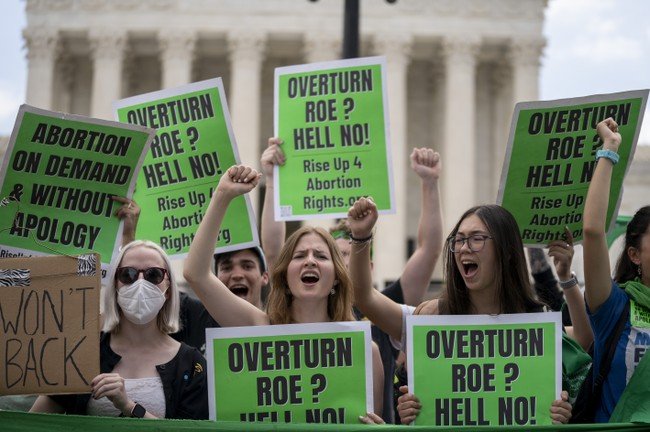
With the overthrow of the United States Supreme Court Roe v. Wade with his Dobbs v. Jackson decision made last month, abortion became the main issue of the election, at least compared to previous years. It is also worth emphasizing that economic issues are more significant to voters. The abortion issue is also sometimes credited with slightly boosting Democrats’ congressional votes as the November midterm elections approach.
One poll showing Democrats will gain is the USA Today/Suffolk University poll released on Thursdaywith a 44 percent advantage compared to the Republicans’ 40 percent advantage.
Republicans still remain favored regain control of the US House of Representatives along with the US Senate considered a toss-up. Polls from previous years underrated Republican electoral successes.
Moreover, according to the USA Today/Suffolk University poll, voters prefer a candidate who will mostly oppose President Joe Biden (47 to 42 percent).
Also boding badly for Biden and the Democrats is the overwhelming majority of voters who believe the country is on the wrong track – a higher percentage than in the case of former President Donald Trump, whose party lost 40 seats in the House of Representatives during his term in the 2018 midterm elections:
According to polls 5-1, 76%-15%, the country is on the wrong track, not in the right direction. Majorities of every demographic group – regardless of party, region, race and age – agree.
The sentiment is more dire than in a USA TODAY/Suffolk poll conducted around this time in 2018, before the first six months of Donald Trump’s presidency. Next, Americans (55-34%) said the nation was on the wrong track – not a rosy assessment, but double-digit optimism than we currently have. Trump’s approval rating then was 40-56%, almost exactly the same as Biden’s current approval rating of 39-56%.
Abortion has outpaced inflation in the number of respondents who consider it the most significant issue. In an open-ended question, 20 percent cited the economy as their most significant problem, 16 percent identified abortion and 11 percent identified inflation. In the justification for the survey, it was noted that the issue of abortion was “fueled by… last month’s Supreme Court ruling repealing the recognition of access to abortion as a constitutionally protected right.”
However, the USA Today article itself emphasizes the importance of the economy, especially after Thursday’s GDP data showed negative growth, thus pointing to a recession.
As indicated in a survey report published shortly before the release of the GDP data:
Concerns about the economy and inflation they drive political debate. Growth data released Thursday will show whether the economy has contracted in two consecutive quarters, a common definition of a recession, but 50% of Americans say a recession has already arrived.
Only 9% say the economy is currently in recovery.
…
“For these respondents, recession is not a perception; this is reality,” said David Paleologos, director of the Suffolk Center for Policy Research. “Lower-income households have been hit particularly hard by having to make crucial choices about how to allocate every dollar they have.”
For Julie Clifford, 62, a Republican from Burleson, Texas, it’s the economy that counts. The highest inflation in four decades has made life harder for people like her who have a fixed income, said the retired engineer. “We just have to make choices about what we’re going to do and the things we planned to do in retirement that we can’t do now because we have to be careful with money when it comes to the basics.”
She’s not alone. In the survey, 58% say they go out to eat less often because of inflation. Nearly half, 48%, say they drive less often; 45% limit grocery shopping; and 45% postpone or cancel travel or vacation plans.
Among households with an annual income of less than $50,000, 70% eat out less often, 60% cut back on grocery spending, and 60% drive less.
Commenting on the issue of abortion in this survey, Michael New, assistant professor of practice at the Busch School of the Catholic University of America and Associate Scholar at the Charlotte Lozier Institute, emphasized that other issues are more important. “From Dobbs decision, abortion became a more significant political issue. But almost every poll shows that inflation, gas prices and the economy are higher priorities for voters,” Townhall said.
The poll was conducted among a sample of 1,000 registered voters July 22–25, with a margin of error of 3.1 percentage points.
When it comes to abortion, polls often ask respondents whether they approve or disapprove of a Supreme Court overturn Roe, also after the Court officially did so.
Polls consistently show that respondents are not in favor of overthrowing the government Roe. Such results, while consistent, are at odds with what respondents may actually want, suggesting that they can be confused with what a refutation is Roe actually entailed. The Dobbs the decision merely returned the abortion decision back to states that respondents, when asked otherwise, appear to favor.
No wonder then CNN poll on Thursday, he posted the takeaway that “About two-thirds of Americans disagree with the overthrow Roe v. Wadesee the negative effects on the future nation.”
“At the beginning of this year, the Supreme Court repealed Art Roe v. Wade decision and ruled that women did not have a constitutional right to an abortion. How do you feel about the Court’s overturning? Roe v. Wade?” – respondents asked in the survey.
Sixty-three percent said they disagreed with the decision, including 51 percent who “strongly disagreed.” Thirty-seven percent approved the decision.
The survey does not appear to have informed respondents that Dobbs the decision merely sends the abortion issue back to the states for them to decide. One question was asked who accept this decision whether they believe politicians “should push for further abortion restrictions nationwide,” which 20 percent did, and 80 percent believed they “should leave decisions on abortion restrictions to the states.”
Moreover, although the poll results and the CNN report emphasize this so-called “constitutional right to abortion,” the Supreme Court said in a ruling Dobbs that there is no such constitutional right and that the Court erred in ruling Roe v. Wade and chance Planned Parenthood v. Casey. Justice Samuel Alito in writing opinion for the Courtt, discusses this issue, as does the concurrence of the justices who also voted for the repeal Roe.
“Views on the ruling are closely tied to a mix of ideology and party, with majorities disagreeing with liberal Democrats (93%), moderate or conservative Democrats (81%), independents (71%), and moderate or liberal Republicans (55%). ) However, among conservative Republicans, 85% say they approve of the ruling,” is not a surprise in the text of the poll.
Republicans made up just 30 percent of survey respondents, Democrats 32 percent and independents/other 38 percent.
The poll also found that 68 percent responded that the decision would have a negative impact on the United States as a whole, including 51 percent who said it would have a “major negative impact.” A majority (58%) also said the decision would have a negative impact on women in their state, even as some liberal states like New York, California and Illinois are doubling down on their pro-abortion stance.
The Dobbs the decision did change the United States when it came to abortion, but by bringing it more into line with the requirements of the international community. Under Roe, The United States was one of only seven countries in the world to allow elective abortions in the past 20 weeks, including China and North Korea. There is no indication that respondents were aware of this.
Respondents don’t even believe it Dobbs will touch them personally. Sixty percent said it would have no impact on them or their family.
Not surprisingly, this statement was hidden in the penultimate paragraph of the CNN article.
“In the aftermath Dobbs decision, three national polls, Harvard Harris, Pew and ABC News found that Dobbs The decision was approved by over 40 percent. Therefore, there is a good chance that the CNN poll will turn out to be an outlier. This poll was also conducted in the wake of press reports about the tragic rape of a one-year-old girl in Ohio, which may have resulted in decreased pro-life sentiment,” New also commented for Townhall.
He added: “Of course abortion can benefit pro-life candidates. Since lawmakers can now pass laws to protect unborn children, it could give pro-life voters additional motivation.”
The survey was conducted online July 22–24 among a sample of 1,002 adults, with a sampling error of plus or minus 4 points.