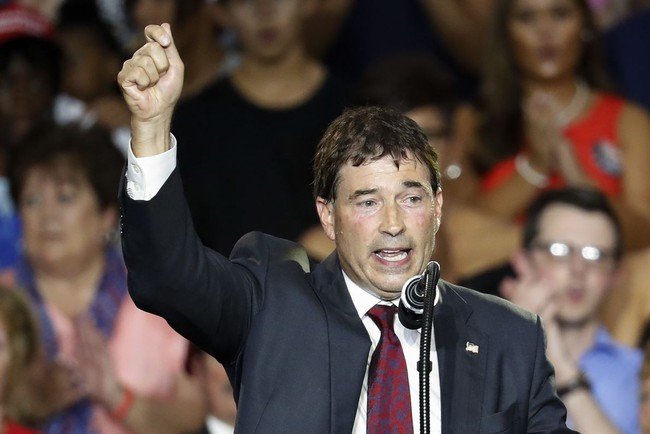
Last week, Republican Troy Balderson struggled to defeat Democrat Danny O’Connor in a House runoff election in suburban Columbus, an Ohio district that the GOP has controlled for decades and that President Trump won by 11 percentage points two years ago. (The race—still too close to call with a 1,564-vote margin—won’t be called until Aug. 24, when all mail-in ballots are counted.)
In March, Republican Rick Saccone lost a runoff election to Democrat Conor Lamb in Pennsylvania, another district that voted heavily for Trump.
Both Ohio and Pennsylvania represent a fresh coalition of Trump voters: Rust Belt states that were expected to vote Republican in 2016 but instead chose an unorthodox billionaire who promised to “Make America Great Again.”
So why, two years later, is the GOP having so much trouble connecting with these people? Is it Trump? The party establishment?
Ohio Gov. John Kasich said Balderson’s impoverished showing was a referendum on the president. “The people here sent a message to Republicans to stop this,” Kasich told CBS News last week. “Stop the chaos, the division, stop this separating of families that we see at the border, or taking away people’s health care. I think they — they’ve basically had enough, and they’re sending a message to Republicans, including a Republican in the White House. … This district is so Republican that it should never have had an election here. And it was so close, and — in one of the counties that is so solidly Republican — where a Republican would normally win by 70 percent, it broke basically 50-50.”
But Kasich, who has not yet ruled out a 2020 presidential run, has the wrong perspective. The GOP’s problem isn’t the president. The problem is the message.
Trump is the sun around which the solar system of American politics revolves. You cannot outshine him.
And his base is solid. An August survey of verified Trump voters by the Pew American Trends Panel found that a solid majority of those who supported him in 2016 still feel warmly about him and his presidency.
The survey found that 82 percent of people who voted for Trump said they still had “warm” feelings toward him in March, while 62 percent said they had “very warm” feelings toward him.
One could argue that Democratic candidates have it easier because they can freely oppose Trump in order to unite their electorate.
Republicans, meanwhile, can’t just be pro-Trump. They have to find a way to reach people in educated, affluent suburbs who are likely to be turned off by the president’s rhetoric while still supporting his fresh populist coalition of working-class and irregular GOP voters. But Dave Myhal, an Ohio-based Republican strategist who lives in Columbus, says connecting regular Republicans with irregular populist voters shouldn’t be all that complicated.
The key is not national issues. It’s local issues.
Infrastructure projects like bridges, roads and sewage systems are significant to everyone. Addressing the issue of keeping newborn people in the area appeals to both suburban and rural parents. So does creating jobs or expanding broadband internet for rural children who want to work in agriculture, industry or miniature businesses.
“The fact that my party didn’t learn how to reach their voters after Conor Lamb’s defeat and continued to do the same thing shows that they still don’t get it,” Myhal said. He said both Saccone and Balderson should have “steal a page out of Danny O’Connor and Conor Lamb’s playbook and focused on local issues — they both did a really good job.”
John Lapp, a Washington Democratic strategist, agrees. “The fact that Republicans have to spend more than $4 million to hold on to a ruby-red House district is certainly a sign of their challenge to attract voters this fall,” he said.
House special elections typically do not predict the fate of parties in the run-off elections. Democrats lost all the run-off elections prior to the 2006 run-off elections, only to flip the House by 30 seats; four years later, Republicans lost all the run-off elections prior to the 2010 run-off elections and defeated Democrats, regaining 63 seats.
“People make too much of the specials. It’s kind of like preseason football — it’s a good way to fix an organization’s problems — but it’s nothing like the regular season,” Lapp said. But it’s a crucial time to start learning some very significant lessons before the 2018 midterms.
Keeping it local is how you connect the regular suburban Republican voter with the fresh Trump voter. It keeps the electorate on the same page and the candidates’ message laser-focused, Myhal said.
“That’s what they have in common,” he said.
To identify with your constituents is to be present with your constituents. Every Republican candidate for the House of Representatives should be on the ground in his district, talking about local issues and rejecting national, formulaic ads created by people who have never set foot on their Main Street.
Whether it’s a suburban mom or a blue-collar worker, voters will be willing to listen to and connect with a candidate who makes them feel like they’re part of their community — and part of something bigger than themselves.
That’s why Trump won in 2016 and formed a coalition in the first place.