Public funerals have become somewhat of a unique tradition in American politics. While in the past, deceased politicians and even famed artists were put on public display—whether it was Abraham Lincoln or John F. Kennedy—they were largely honorary, dignified ceremonies to honor the deceased and dutifully record their lives of service and sacrifice. At this point in our American civilization, however, that trend seems to be reversing, and much of that has to do with the intense media scrutiny that accompanies such public events.
The intense politicization of public funerals seems to be the fashion of our times. While it is not a modern tradition per se—political speeches at funerals of historical figures date back to when the Greek general Pericles spoke at the funerals of Greek soldiers during the Peloponnesian War or when the Roman general Mark Antony spoke at the public funeral of Julius Caesar—the tradition seems to have reached a high art form here in America.
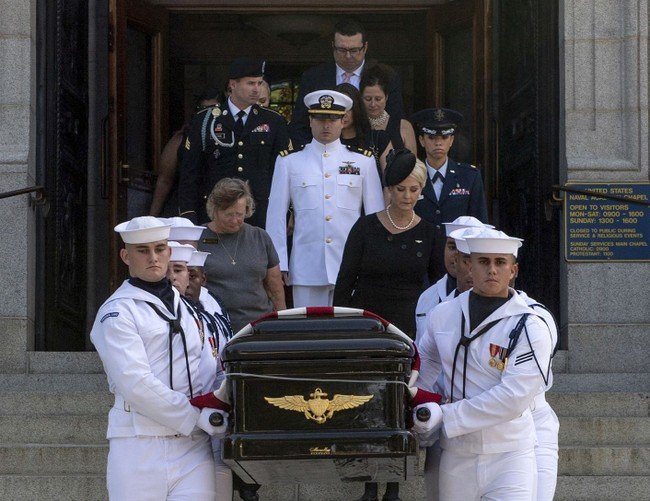
The recent funerals of the delayed Senator John McCain and Representative Elijah Cummings are a case in point. McCain’s death was predicted, most publicly by McCain himself. He rose from his deathbed, where he lay suffering from terminal brain cancer, to cast the final deciding vote in the U.S. Senate to save the Affordable Care Act from certain defeat. In doing so, he publicly rebuked a political rival—President Donald Trump—who campaigned demanding on a promise to “repeal and replace Obamacare” on the first day of his administration. Earlier in the presidential campaign, Trump had directly insulted McCain, dismissing his military sacrifices, saying, “I prefer war heroes who didn’t get captured.” This deep, personal insult has stayed with McCain and may have given him the strength to rise up one last time and reject his antagonist.
But it didn’t stop there. McCain called former President Barack Obama a few weeks before his death and asked Obama to deliver his eulogy. Obama and McCain had been bitter partisan adversaries since the 2008 presidential campaign and had been at odds with each other for eight years in Obama’s office. During his eulogy, Obama confessed, “Now, when John called me earlier this year to ask me to do this, I admit I was saddened and also a little surprised.” But the former president, perhaps sensing the political moment, played along anyway. While his eulogy for McCain was an apparent attempt to bury the hatchet, even to restore civility to the partisan debate, it also served a much more sinister purpose: to bury the hatchet in Donald Trump, McCain’s mortal enemy.
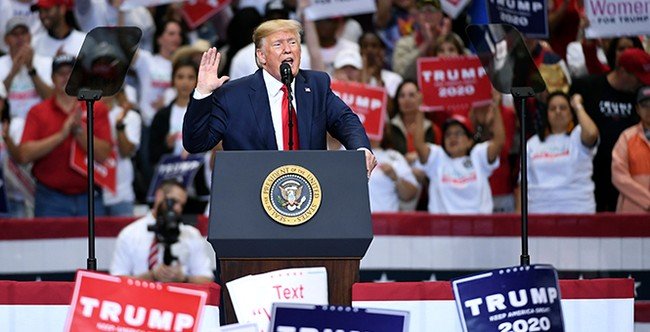
The moment did not go unnoticed by Trump, who was particularly snubbed, as McCain’s wife publicly banned him from attending. It was almost as if everyone else had been invited to Trump’s hometown party, except Trump himself. Trump, in characteristic fashion, responded at a campaign rally a few months later. Speaking at a tank factory in Lima, Ohio, Trump exclaimed, “I gave him the funeral he wanted, and as president, I had to go along with it… I didn’t say thank you, but that’s okay. We sent him, but I was not a fan of John McCain.” Why speak ill of the dead at an Ohio campaign rally? Well, precisely because it wasn’t in Washington. Trump argued that these were his people, the people who elected him, so who cares if he wasn’t invited to an elite Washington insider party? As president, Trump deftly used McCain’s funeral to continue to prove that he was not a corrupt Washington insider but a man of the people.
Last October, another high-profile political funeral was held for former congressman — and another Trump foe — Elijah Cummings. Cummings, a black Democrat representing Baltimore and surrounding counties, had been a persistent critic of the president, even chairing several congressional investigations into alleged wrongdoing by the Trump administration. Perhaps most troubling to the president was the fact that Cummings, as chairman of the House Oversight and Reform Committee, had launched an impeachment inquiry against the president.
Because Cummings was a longtime member of Congress, several congressional leaders, including Senate Majority Leader Mitch McConnell, were in attendance as usual. As they gathered to pay their respects, Cummings’ friend and his pallbearer shook hands one after another—but, tellingly, they refused to shake McConnell’s outstretched hand. The televised insult reverberated throughout the political world—many initially assumed it was a partisan attack on McConnell.
It wasn’t. Although the man, later identified as Bobby Rankin, deliberately refrained from greeting him, his reasons—though rude and dismissive—were not partisan but, in fact, deeply personal. As it turns out, Rankin’s brother had died the previous year of cancer, allegedly caused by drinking contaminated water while serving as a Marine at Camp Lejeune in North Carolina. According to Rankin, his brother had been denied the veterans’ benefits he was entitled to, and he blamed McConnell for not intervening on his brother’s behalf. “When I saw Mitch McConnell, all I saw was my brother’s face,” Rankin said. “I couldn’t put my hands on the hands of a man who refused to help someone who had served his country.”
While the media assumed partisan rancor, the true political significance of the moment was understated. It was that a top Republican in Congress, a well-known national security hawk, was being blamed for letting down a soldier. And, ironically, the soldier’s brother was also a good friend of one of the top doves in Congress. If it’s a truism that politics makes strange bedfellows, then perhaps it’s equally true that political funerals, as the McCain and Cummings funerals prove, make strange bedfellows.
At a funeral oration for a fallen Greek soldier, Pericles wisely observed, “All men praise the dead, and however eminent your virtue may be, I do not say that you should approach them and avoid the lives of their rivals and critics, but when a man is aloof, the honor and kindness he receives are spotless.” We Americans have shortened the admonition to the straightforward phrase, “Do not speak ill of the dead.”
But the rhetorical art of political funerals, especially the act of eulogizing the dead, can often mask an intention to shame living enemies. Just as McCain’s funeral degenerated into a “meeting of the Resistance,” as a writer for the liberal magazine The New Yorker put it, so did the funeral of Julius Caesar, as Shakespeare depicted it in his eponymous play. Antony, a close friend of Caesar’s, sensed the political animus against the recently assassinated leader and immediately sought to allay any concerns about his subsequent eulogy with the infamous lines, “I came to bury Caesar, not to praise him./ The evil that men do lives after them;/ The good is oft buried with their bones.” The line is blistering in both its denial and its accusation. He both criticized the dissenting senators who continued to disregard Caesar and charged that he could somehow continue to do “evil” even after death, concluding that Caesar contained the bones of a man in whom there was some residue of “good.”
The speech continues in a manner almost inverse to most funeral orations, first praising his friend Caesar as a man whose incredible ambition nevertheless allowed him to listen with love to the cries of the destitute, and then introducing Caesar’s main antagonist, Brutus, as a man whose own honorable character should have given him the dignity to at least mourn the man he once loved.