When you look around the political landscape less than a week before the 2022 midterm elections, what do you see?
You see the poll numbers are trending toward a Republican wave victory. They now lead by 3 points in the House vote among likely voters, while FiveThirtyEight has flipped it, showing they have a 53% chance of a Senate majority.
Polls in key state races have shown GOP gains since Labor Day. And even the moderately encouraging Democratic results in the New York Times-Siena College polls in the tight House races were undermined three days later when New York Times analyst Nate Cohn revealed that “there is a wide gap in Democratic and Republican responses.”
Meanwhile, as Democrats have pointed out, you see far more polling from biased Republican pollsters than from biased Democratic pollsters. But there’s a reason for that. As Republican pollster Bill McInturff has argued, biased pollsters and campaign clients don’t report unfavorable results. That suggests Democrats don’t have good news to report.
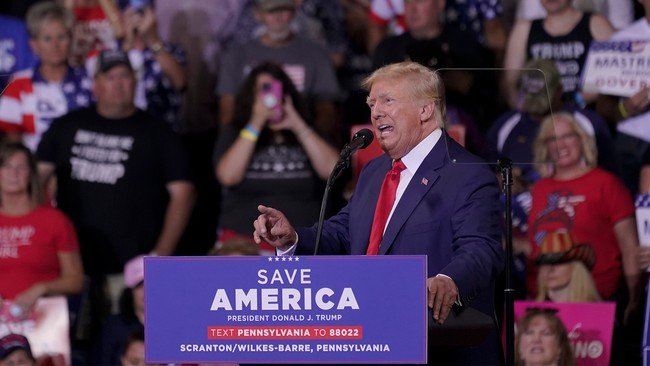
What you don’t see much of is former President Donald Trump. He held several gigantic rallies in states where races were close. Earlier in the cycle, he endorsed primary winners who were predicted to be faint candidates in the general election but who are now clearly running competitive races.
There’s also not much of a presence for President Joe Biden, who turns 80 in three weeks and is campaigning far less in his first midterm election than Trump did at 72 or former President Barack Obama at 49. Biden has mostly stayed in Democratic territory — New York and Maryland, with a gubernatorial candidate in Oregon — in a race Democrats haven’t lost in 40 years.
He has avoided campaigning in three states—Arizona, Nevada and Georgia—where Senate races could decide the majority in that chamber. In the Obama-Biden states of Wisconsin and Ohio, he has been shunned or disowned by the Democratic Senate candidates he was supposed to assist.
Biden appeared in Philadelphia at a fundraiser for Senate candidate John Fetterman three days after his disastrous performance in the Oct. 25 debate. But two post-debate polls show Fetterman losing the lead he enjoyed over Republican Dr. Mehmet Oz. It seems unlikely that Biden’s performance in Florida this week will assist the lagging Democrats overtake “MAGA Republican” Sen. Marco Rubio and Gov. Ron DeSantis.
As for Vice President Kamala Harris, she joined Biden in Philadelphia and is expected to appear in Massachusetts on behalf of the gubernatorial candidate, who is leading in the polls by 25 points. Despite being assigned to cover the border, she is clearly not heading to the Rio Grande Valley, where Democrats could lose three historically protected, Latino-majority House seats.
You can also see what’s happening by looking at where the money has flowed. With the growing support of wealthy white college graduates, Democrats have had little trouble raising gigantic sums of money for incumbent senators whose standing hasn’t improved. They’ve also been spending money on gubernatorial candidates with national media exposure, like Beto O’Rourke in Texas and Stacey Abrams in Georgia, who are losing their races embarrassingly.
But most of that money has been spent on ads focused on abortion and “preserving democracy” themes—themes that thrill committed Democrats but are unappealing to others. Republican blitzes on runaway inflation, runaway crime, and runaway illegal immigration seem to be attracting more votes.
You can see how the battleground has changed by noting that Democrats are spending money on Washington incumbent Patty Murray, who won 59 percent in 2016, and in dozens of House races in Biden’s districts. Democrats in Biden’s double-digit districts suddenly find themselves in jeopardy and begging for donations.
Republicans are capitalizing on the stellar recruiting work of House Minority Leader Kevin McCarthy (R-Calif.). “Seventy percent of Republican candidates in Democratic districts that are most at risk are women, minorities, and/or veterans,” wrote National Review’s Dan McLaughlin. “There are even two candidates who are all three.” Just as the GOP constituency has become more modest and Democratic in the Trump years, but also in the last 20th century, so too has the GOP field.
The party is temperamentally and style-wise positioned to benefit from a backlash against the misguided policies of elites with the right credentials—health officials who insisted that prolonged lockdowns and school and business closures were necessary, academic criminologists who insisted that defunding the police and incarcerating criminals would not raise violent crime, economists who insisted that inflation was transient.
These experts held power for 13 months, from the outbreak of the COVID-19 pandemic in March 2020, through the Black Lives Matter movement and anti-fascist riots this summer, and on to Biden’s $1.9 trillion COVID-19 relief bill in March 2021. The fallout from their actions is still being felt.
On the political side, there were Democrats who followed the advice of pundits and supported things like closing schools and defunding the police — policies that New York Magazine journalist Jonathan Chait called “indefensible and discreditable positions” by “the most unwise people on the left” and Josh Barro called “the stupid things the Groups signed up to in June 2020 because the people who work in the Groups are the most out-of-touch people on the planet.”
You’ll see the scale of the destruction on election night next Tuesday. You can expect the tone to be set early with early results coming in from what was once the most closely contested major state in the country, Florida. Polls suggest a double-digit victory for DeSantis and a high-single-digit lead for Rubio — and no other Floridian, Trump.