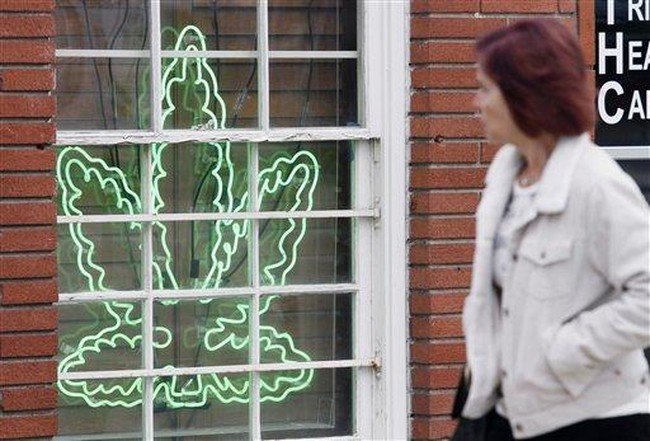
“We have to hold every drug user accountable,” Senator Joe Biden declared in 1989, “because if there were no drug users, there would be no appetite for drugs and there would be no market for them.” The mass pardons for petty marijuana offenders that the president announced last week show how far he has come since his days as a hardcore drug warrior, even if it shows he is still out of step with the times.
Biden’s decision applies to anyone convicted of marijuana possession under the Controlled Substances Act or the District of Columbia code. He said the pardons would facilitate “thousands of individuals who have previously been convicted of marijuana possession” and “who may be denied employment, housing, or educational opportunities as a result.”
As an act of clemency, a blanket pardon is huge. But in the context of prohibition, which has generated nearly 29 million arrests since 1965, it looks less impressive. Rep. Dave Joyce (R-Ohio), co-chair of the Congressional Cannabis Caucus, notes that “more than 14 million marijuana-related records at the state and local level continue to prevent Americans from stable housing and gainful employment.”
Because marijuana possession is rarely prosecuted at the federal level, the enormous majority of such cases fall outside the president’s pardon authority. But Biden’s clemency did not apply to people convicted of producing or distributing marijuana under federal law, who continue to languish in prison or face lifetime criminal records.
The injustice of this situation is especially striking now that most states treat these federal crimes as legitimate business activities. Depending on the jurisdiction, the same conduct that can send someone to federal prison for years, decades, or even life can make someone else a wealthy and respected entrepreneur.
Biden alone lacks the authority to resolve the untenable conflict between state and federal marijuana laws. Yet despite his avowed transformation from anti-drug zealot to criminal justice reformer, he has stubbornly opposed efforts to repeal federal marijuana prohibition.
That position flies in the face of the preferences of more than two-thirds of Americans, including four-fifths of Democrats and half of Republicans. The most Biden has been willing to offer them is rhetorical support for decriminalizing marijuana consumption — a policy that was at the forefront of marijuana reform in the 1970s.
Fifty years ago, when fewer than 20 percent of Americans thought marijuana should be legal, Nixon’s Shafer Commission recommended that “personal possession of marijuana should no longer be a crime.” President Jimmy Carter supported decriminalization in 1977, when he told Congress that “penalties for possession of a drug should be no more harmful to the individual than the use of the drug itself.”
Half a century later, Biden has finally come around to that position. “Sending people to prison for marijuana possession has upended too many lives — for conduct that is legal in many states,” he said on Twitter last week.
The same, of course, applies to sending people to prison for growing or selling marijuana, although Biden refuses to admit to that. The moral logic of his distinction between plain possession and other marijuana-related crimes is strenuous to fathom.
In 1989, when Biden wanted to show that Democrats could be even tougher on drugs than Republicans, he correctly identified the source of the problem he was fighting: Americans who defied the law by choosing to consume drugs that Congress had arbitrarily banned. Without those individual decisions, he noted, there would be no black market to suppress.
Now Biden says marijuana utilize shouldn’t be treated as a crime. But if so, how aggregate People utilize marijuana does that justify arresting, prosecuting and imprisoning anyone?
There is no satisfactory answer to that question. And even as Biden acknowledges the grave harm done by “our failed approach to marijuana,” he has not attempted to provide one.