
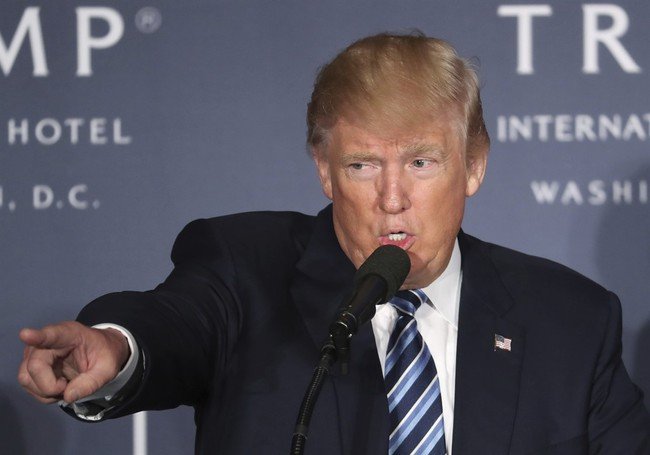
Could Donald Trump’s shaky campaign hurt Republicans in the lower polls and cost the party majorities in the Senate and House? That seems possible if he loses to Hillary Clinton by a margin similar to most current polls, and if Americans vote for all parties, as they have increasingly done in recent years.
The trend is startling. In 2012, only 4 percent of voters chose Barack Obama and the Republican congressional candidate, and only 6 percent chose Mitt Romney and the Democrat. That 10 percent was the lowest result since the question was first asked in 1952.
Similarly, only 26 congressional districts voted for a presidential candidate from one party and a congressman from the other. That’s the lowest such number since 1920. It’s also part of a long-term trend: Fewer districts split their slates this way between 1992 and 2012 than in any election between 1956 and 1988.
One reason was the growing convergence between the positions and priorities of the presidential and congressional candidates of both parties. After the virtual erasure of moderate Blue Dog Democrats in 2010, there were few Romney-leaning Democrats or Obama-leaning Republicans running anywhere.
This year is different. There is an obvious difference in Donald Trump’s positions and priorities from most of the Republican candidates, and not just because the latter don’t spend their days condemning judge Gonzalo Curiel or Miss Universe. Dozens of Republican candidates have made clear, in various verbal formulations, their lack of support or dislike for the presidential candidate.
Polls in the closely contested Senate races show that many voters realize this: Hyperactive octogenarians Chuck Grassley in Iowa and John McCain in Arizona—after 36 and 30 years in the Senate, respectively—are ahead of Trump, as well as Mitt Romney’s 2012 performance in their states.
Incumbent Republican senators with stern rivals also are comfortably ahead of Trump and Romney in Florida (Marco Rubio), Illinois (Mark Kirk), New Hampshire (Kelly Ayotte), Ohio (Rob Portman), Pennsylvania (Pat Toomey) and Wisconsin (Ron Johnson). Their prospects are mixed but defying any declines.
Closer to Trump and Romney are Richard Burr of North Carolina and Johnny Isakson of Georgia, neither of whom campaigned heavily in a state that has traditionally leaned Republican.
In Nevada, Republican Joe Heck is in a close race to win Harry Reid’s open seat — the GOP’s only shot at the Senate. But Heck’s withdrawal from Trump after “Access Hollywood” could hurt him in a state where many whites without college degrees gave Trump a substantial win in early primaries. Heck is doing better than Romney, but not better than Trump.
Missouri and Indiana, apparently safe and sound for Trump, have stern Senate races. Both have vast swaths of Southern-accented Democratic ancestry and were close in the 2008 presidential race.
In Missouri, Democrat Jason Kander, with an ad showing him assembling a military-style rifle while blindfolded, is about evenly matched with Republican incumbent Roy Blunt. In Indiana, Democrat Evan Bayh, considered a moderate when he was elected governor in 1988 and 1992 and senator in 1998 and 2004, jumped into the race in July. Bayh has been criticized for his fictitious Indiana residence and for seeking lobbying work while he was still a senator in 2010, but he is leading narrowly in recent polls.
So personal factors and local idiosyncrasies are shaping Senate races, as they did in the pre-Trump years. And they appear to be doing the same in House races, judging by the scant public polling available.
Republicans running in districts with high college graduates have been nurturing them since before Trump came along; those with high Latino populations have learned enough Spanish to debate en espanol. And Republicans running in districts with high white non-college graduates (a demographic that Trump has done better than Romney)—the plains of Iowa, the northern woods of Maine, Minnesota—may not see a decline at all.
One major risk for Republicans is that Trump’s talk of a stolen election could discourage Republican-leaning voters from voting. And some of the GOP’s adjustments to local terrain could go unnoticed amid the media frenzy surrounding Trump’s latest outrage.
But so far, the low-level elections look less like the head-to-head battles of recent years, in which few candidates significantly outperformed or lost to the party nominees, and more like the elections of the 1970s and 1980s, in which many incumbents and challengers, mostly Democrats but also Republicans, constantly improvised and created personas tailored to their voters and able to distinguish them from unpopular national party leaders.


