
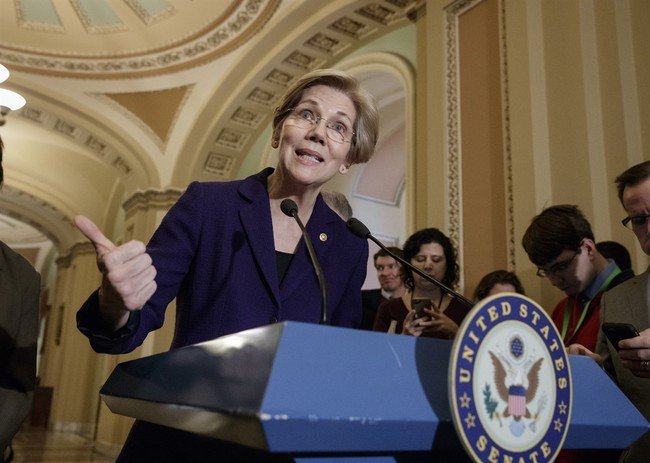
Senator Elizabeth Warren (D-MA) is becoming one of the most brutal critics of the Trump administration. She is rumored to be a candidate for the 2020 nomination, although I think it’s way too early to think about the next election. From her appearance on Rachel Maddow’s MSNBC show this week, we can tell that she doesn’t understand why Democrats lost in 2020. The path out of this is not arduous. Reach out to the tens of millions of white, working-class voters who dot rural America, talk about jobs, pension protections, better trade deals, and forget about political correctness. These voters are staunch Republicans; they are undecided voters. But Warren thought it would be easier to simply say that white working-class concerns are based in part on racism, a heated stew of racism (via Hill):
Sen. Elizabeth Warren (D-Mass.) said Wednesday that President Trump’s election victory in November was in part the result of an “ugly mix of racism.”
Asked by MSNBC’s Rachel Maddow why white middle-class voters voted for Trump, Warren said the real estate mogul was able to tap into deep-seated anger among low- and middle-income voters by blaming ethnic and religious minorities.
“Some of it is a nasty stew of racism,” Warren said. “Some of it is Donald Trump tapping into anger. He understood that people are deeply angry.”
Chris Arnade from The Guardian traveled 100,000 miles areas that Trump talks about in his speeches and that Democrats should focus on if they want to take back Congress and the presidency. He found that even those who don’t support Trump and think he’s crazy weren’t surprised that he won. One man Arnade met on his travels, Anthony Rice, an African-American living in Youngstown, Ohio, said, “Obama promised a lot and didn’t deliver. Maybe New York delivered. This street here is still full of broken-down houses.”
If we move beyond the successful neighborhoods of DC, New York, and elite college campuses—beyond the places where dominant sociopolitical opinions are formed—we see a different America.
This is not a more “real” America—a superficial and offensive cliché—it is simply a different America. This is an America that values and experiences things differently, emphasizing community and faith rather than career or educational status. This is an America that has been on a downward trajectory for decades, with job losses and inner cities drained of energy and filled with drugs. This has made it arduous to stay in these communities.
In this America, hope fades, not grows. People’s lives are a constant tangle of shifting and uncertain jobs. The path that offers a way out – education – requires from a adolescent age to squeeze through a narrow needle of opportunity. If that diminutive chance is wasted, it means a lifetime of feeling that the “other America” is looking down on them.
In these cities, the statement “America is already great” sounds empty and offensive.
And for all that, saying they voted based on racism is typical liberal bubble logic that cost the Democrats the race. It’s part of the patronizing superiority convoluted that liberals have with their politics. They’re always right, so when people disagree — those people are racists, sexists, misogynists, transphobes, or Islamophobes, because that’s the easiest thing to do. No wonder people rejected them by the tens of millions. The only advantage Democrats have is that California, which is full of liberals, was able to give Hillary Clinton a few million more votes, which advanced the uninteresting and worthless argument that she won more votes. Yes, she won more votes, but not a majority. Trump is the president and she’s not, but the truth is that Democrats will parasitize on anything that belittles and discredits Trump.
Warren currently appears to be building her 2020 candidacy with a book tour that even some die-hard liberals say is a bit lightweight on details. So while Warren’s claim that Trumpland is motivated by racism is simply a rehash of Clinton’s regrettable remarks, her “This fight is our fight” to save the very people she called racists is described as patronizing incomplete plan which shows her limitations in understanding American society. Ouch. And by the way, Paul Krugman was the person who described this manuscript as a mile-wide, inch-deep manifesto of the progressive renaissance. I think Emma Green of The Atlantic book review says it all; especially since this is just a louder version of the Clinton campaign. Warren and company can call Trump supporters whatever they want. They still don’t get it.
Warren’s book also exposes moral languages the senator is incapable of speaking. She never really grapples with why Democrats lost, why middle-class voters would choose Trump, or whether their anger might be about more than the economy. Warren sees the world through a narrow lens of economic interests, ignoring the deeply held values and beliefs that often inform people’s politics. This posture is patronizing, but more importantly, it limits Warren’s understanding of America—and why her party has failed so badly.
Warren has a playbook for Democrats: Talk about the middle class, not the needy. Focus on regulation and corruption, not taxes and spending. And point out the hypocrisy and corruption of the other side at every opportunity. She details policy proposals in bullet points and anecdotes, mixing stories from her Oklahoma childhood with tales of middle-class Americans who worked rigid but still struggled with money.
The slogan, “This Fight is Our Fight,” could successfully serve as a national campaign slogan, completely different from Clinton’s slogan, “Stronger Together.”
[…]
But the story Warren tells about the election and America’s unrest is oddly one-dimensional. She uses standard progressive math to explain Trump voters: some are racist bigots, some have been duped by a casino owner, and some are suffering from deep economic despair. One of the women she follows, Gina, lives in a mobile home in a diminutive North Carolina town. She and her husband are scraping by on her hourly wage from Walmart. “We have to tell this story!” Gina tells Warren. “But I really need this job.”
Gina, we learn behind schedule in the book, “proudly voted for Donald Trump, hoping he would ‘shake things up.’” In Warren’s world, the Democratic Party would win the votes of every Gina in America, fighting for a “playing field that wasn’t so heavily tilted against her.” But Warren never really tells us why America’s Ginas aren’t voting Democratic now.


