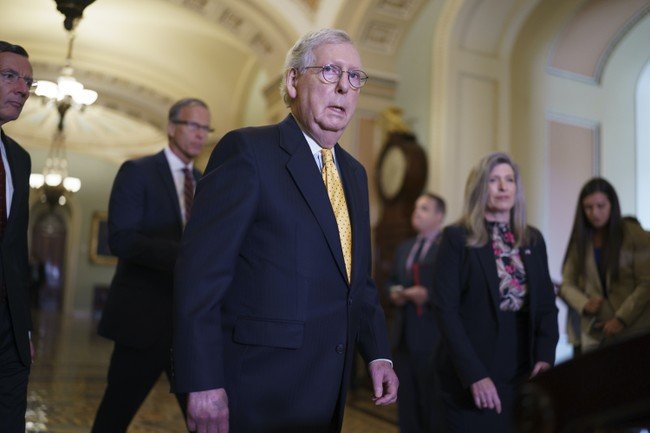
Republican Party leaders in the Ohio House of Representatives are doubling down on their threat to cut public school spending, with House Speaker Matt Huffman calling continuing the current fair school funding plan a “fantasy” and predicting $650 million in cuts.
Ohio’s history with school funding has not been the happiest. In 1997, the Ohio Supreme Court ruled that the way the state funds schools was unconstitutional and relied excessively on property taxes.
Over the next three decades, lawmakers changed the policy to try to fix the unconstitutionality. The Ohio Education Association, as well as lawmakers from both parties, have since argued it is unconstitutional. Some Republicans, however, argue that because they no longer apply the struck down policy and because nothing else has been found by the court to be “unconstitutional” by definition, it cannot be declared unconstitutional.
Either way, there have been bipartisan efforts for years to fix the funding system.
House Bill 1, introduced by state Reps. Bride Sweeney (D-Cleveland) and Jamie Callender (R-Concord) in 2021, would require an additional $333 million annually in K-12 education funding – a total of approximately $2 billion w over three two-year budget cycles. It’s called the Cupp-Paterson Fair School Financing Plan.
Their bill mirrored policies previously passed by the House but not the Senate in the General Assembly, which were authored by former Speaker Bob Cupp (R-Lima) and former state Republican John Patterson (D-Jefferson). House Bill 1 was finally passed and signed into law.
It was expected to take six years to implement and is expected to change the way public money is given to K-12 schools. This would provide additional support to local neighborhoods so they could rely less on property taxes.
The first two years were partially financed, the second two years were fully financed, and there are only two years left.
In early January, comments from fresh House Speaker Matt Huffman (R-Lima) angered viewers, readers, parents and education leaders across the state.
“I don’t think there will be a third phase of Cupp-Patterson,” Huffman told reporters. “In terms of expectations that these things will be implemented… I think the clear statement I can make is that I think this increase in spending is unsustainable.”
He said the General Assembly from four years ago shouldn’t be able to “bind” what future lawmakers might do.
We did a follow-up story after a half-dozen GOP lawmakers personally contacted us and vowed to protect K-12 education.
These six and at least 15 others we spoke to in recent weeks say supporting public schools is one of their top priorities.
That’s because Gov. Mike DeWine hasn’t committed to supporting the current bipartisan funding formula, saying “difficult choices” will have to be made.
Doubling
Warrensville Heights City Schools has 2,000 students, and Superintendent Donald Jolly said a quarter of them have special needs.
Jolly said the current school funding formula provides financial support for schools, and the district spends money to support every student succeed.
“We get a lot of support in terms of reading interventions, students with special needs and so on,” the superintendent said.
But he said Huffman would force them to cut reading and math specialists and other beneficial programs.
The speaker wants to cut at least $650 million from public education spending from the General Assembly budget.
We raised this topic with Huffman again on Tuesday, including the reaction he received.
“Implementing the Cupp-Patterson plan, which many believers say is a fait accompli that we decided four years ago that we would do in this budget, in my opinion, is a fantasy,” the speaker said.
Huffman explained that there will be significantly less money in this year’s budget due to the drying up of federal dollars related to the pandemic. And for him, public education is in the balance.
“What is the cheapest, acceptable educational product for the taxpayer?” Huffman asked rhetorically. “If someone says they’re willing to take a $7,000 scholarship voucher and go to a private school rather than go to a school that… on average in the state costs about $15,000 — that’s better for taxpayers.”
According to the Legislative Services Commission, Huffman is referring to average operating expenses per student.
For the speaker, the choice that meets his question is the private school voucher system. Huffman is an advocate for private school vouchers, and the state spends about $1 billion in public funds to send children to private, for-profit and religious schools.
Huffman and many GOP politicians believe that spending so much on private school vouchers is necessary to ensure that the money “follows the child” or that students avoid low-performing public schools.
“There is no one-size-fits-all educational system,” Gov. Jon Husted said during a news conference, addressing different types of schools.
However, for public schools, the private school voucher program sucks money out of them, and the voucher system is not recorded for transparency.
“You’d think that with $1 billion in public investment, we’d be very concerned about what exactly that’s going to do,” said Parma City Schools Superintendent Charles Smialek. “And yet we don’t have any kind of report that could generate that type of information for us.”
Śmielek said public schools are held to higher standards than private schools.
We questioned Huffman about the lack of transparency when it comes to state money.
“Talking about public education spending and spending it wisely,” this reporter trailed off.
“Ish,” Huffman interrupted.
“We don’t know what the vouchers are spent on,” this reporter continued. “Should we feel more responsible for this?”
“Yes, I think the responsibility is big,” he replied. “Of course there is private responsibility – it is the responsibility of parents and the people who deal with it.”
He added that liability also stems from his claim that the vouchers are inexpensive compared to the per-pupil amount in public schools.
“One of the measures is accountability [if] they are educating this Ohio child, if the cost of the voucher is $7,000… then the liability is cheaper,” he said. “I don’t think anyone would question that.”
He gave an example of how the state will know whether Bishop Hartley, a Catholic school in Columbus, is “doing what it wants.”
“Well, there are a lot of people who send their kids to Bishop Hartley or Temple Christian in Lima or places like that,” he continued.
There are also many people who send their children to public schools – this is the enormous majority of students in the country – argued Śmielek.
“We are extremely fiscally responsible and welcome any inspection,” he said. “If you actually walk down our halls and actually look at our books, what exactly would you cut out? What exactly are we doing that is not meeting the needs of our community?”
Huffman added, however, that it would be “appropriate” to have conversations about some aspects of accountability for voucher programs.
Everyone can see how public schools spend money, especially on special needs programs. Jolly added that these are children that many private schools are unable to accommodate.
“We can’t say you don’t fit in, go to another school,” he said, adding that he would never do that to a child and that their district supports all students.
Despite the overwhelming backlash, the reaction to Huffman doesn’t change his mind.
“If people are upset about this, they still need to deal with the facts,” the speaker said. “I think the current system, especially if we did the third part of the plan, as some people call it, is really unsustainable.”
There is a clear dislike between the operation of public schools and schools receiving vouchers.
“When you have a legislator who is primarily concerned with marketing for them, marketing these vouchers — obviously people who haven’t done this research are going to follow,” Jolly said.
Superintendents hope lawmakers will actually fight Huffman’s plan.
“It’s a marketing scheme that exists because public schools have given everyone a black eye,” Jolly said.
This article was originally published on News5Cleveland.com and are published in the Ohio Capital Journal under a content sharing agreement. Unlike other OCJ articles, it is not available for free republication on other news outlets because it is owned by WEWS in Cleveland.
Follow WEWS House of Representatives reporter Morgan Trau on X AND Facebook.
YOU MAKE OUR WORK POSSIBLE.