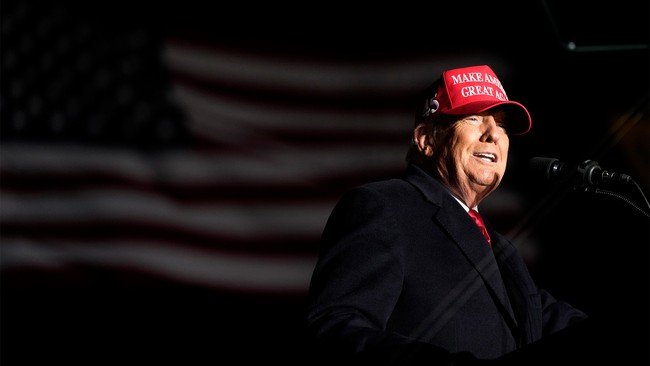
NEW ALEXANDRIA, Pa. – Since former President Donald Trump lost to President Joe Biden in 2020, a “Trump 2024” flag has hung over the house near where I live – one of thousands I have seen across the country over the past two years. But yesterday, when I drove past this house, this sign was no longer there.
The Trump flag is a phenomenon I have written about for years. I noticed that it wasn’t really about Trump himself. This mainly involved the conservative populist movement using the name of its sole standard bearer to let people know they weren’t going anywhere. At this point, no one else stepped in to fill the void. And so the flag had Trump’s name on it.
When the “Let’s Go Brandon” moment happened, many of those Trump signs were replaced with Brandon signs. If you have never understood the conservative populist movement, the importance of this may escape you. It was always about being part of something. And for a while, it was about supporting Trump.
I don’t know if the owner removed the flag or if it fell down after two years because no one opened the door for me to answer this question. But it made me wonder whether, in the week after the election, when many of his voters blamed him for the failure of the red wave, whether that attitude had waned among some of them. Could it be that some or many of Trump’s diehard supporters were ready to move on?
What made Trump inspire voters in places like central Appalachia was that he recognized their strengths, which had long been ignored and often ridiculed by cultural elites. The media, political parties, corporations, Hollywood and academia have looked down on ordinary people who live here and basically anywhere more than 20 minutes from major metropolitan areas. However, these people have their pride. They still value the resourcefulness their parents and grandparents taught them to survive when an economic crisis creeps into their hometowns. They know how to hunt and smoke meat, raise chickens, run a family budget, and work with their hands all day long. They rarely expected alms, let alone believed they were entitled to them or to anything at all.
Although many of these voters were a generation removed from some of the traditions and crafts their parents practiced, they were still very much a part of their cultural identity. Their coalition was formed long before Trump came down the stairs in 2015. He was never the cause; they were already there, waiting for the right person to speak on their behalf. He was the result.
They showed up and voted in the 2006 midterm elections against the Republican establishment. Some of them voted for Barack Obama in 2008 because of his aspirational message, and two years later they voted for the Republican because he did not meet the ideals that guided him.
They were not inspired by Mitt Romney in 2012, so they waited – Obama became the occasional president who won fewer votes during re-election than in his first term. But they came out robust in the 2014 midterm elections, and by 2016 they recognized Trump as the only one who understood their potential. His message was about them, not him. And it worked.
By 2020, this message was only about him. After the election, there was even more news about him. But voters didn’t leave as political observers thought because there was no one to fill the vacuum. So they stayed. Everything started to become clear when the governors of Georgia, Florida and New Hampshire showed that they could take over as cultural curators while still being able to govern. When the three, along with Gov. Mike DeWine in Ohio, won sweeping victories in their states last week, some voters began to vocalize their willingness to move on.
Many of them stayed home last Tuesday due to Trump’s decision that the midterm election results would focus solely on him. They worried that his picks would be dependent on his every whim rather than what was crucial to them, and the red tide died on the vine.
In tiny, Trump started getting it wrong, and the media has always got it wrong about these voters. They do not live by a creed filled with resentment and regret. Their aspirations are for communities, families and the future, and they vote accordingly.
There is an crucial nuance to this move away from Trump. It’s not because they don’t appreciate his policies, or his ability to make people feel that patriotism is okay, or his influence on the Supreme Court – every supporter interviewed last week deeply appreciates that – it’s simply that they are ready to move forward.
Bruce Haynes, a South Carolina native and conservative strategist, said there are 900 ways to express this. “When Trump assumed he would defend voters’ grievances, they were on his side,” he said. “At some point, it stopped being about the voters and started about his personal grievances. And then he started losing voters.”
There’s another element that’s quite tough for him, Haynes said. “Much of Trump’s ethos was based on winning, but now some are accusing him of a significant losing streak,” he said. “The narrative is that he has never won more votes in a general election than a Democrat, he lost the House and the Senate in 2018, he lost the presidency, and now he is being credited with losing this year’s midterm campaign. This narrative goes to the heart of his brand. “
The good news for the conservative populist coalition is that it has not collapsed; in fact, he has grown. It even attracted up-to-date Latino and black voters. The people the movement is likely to turn off are those who rarely voted before Trump came along; they were the least ideological and focused more on Trump than the rest of the coalition. He didn’t have to win for them; they just liked him because he was a unicorn in a business full of suits.
Club for Growth, a conservative anti-tax organization, released a series of polls on the same day that Trump announced his re-election bid at his Florida resort. The poll notes show the former president losing a double-digit lead over Florida Gov. Ron DeSantis in head-to-head matchups in the early primary voting states of Iowa and New Hampshire, the first two states on the GOP nominating calendar. The poll also showed DeSantis leading in the Sunshine State and Georgia, where runoffs will be held next month.
“He used to say ‘they,’ now he says ‘I,'” Haynes said. “This is where he lost people – he stood up for them, and now he is seen as defending himself.”