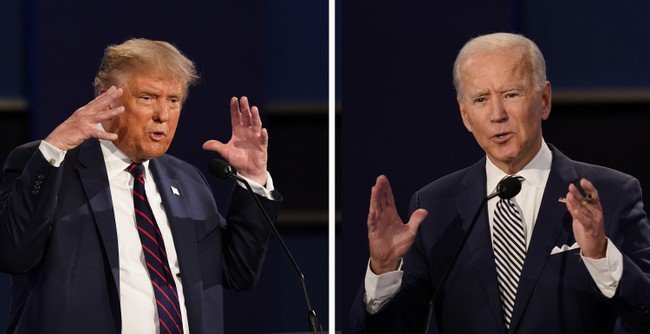
Democrats are acting dismayed that President Donald Trump’s legal team is still challenging the November 3 election results three weeks after a day, while many Trump supporters note that Democrat Al Gore has kept his legal challenge alive for 36 days.
The natural tendency is to compare the post-election conundrum of 2020 with 2000, primarily because it is a reference point that most voters remember at least to some extent. However, a better comparison would be the 1876 election between Republican Rutherford B. Hayes, Governor of Ohio, and Democrat Samuel Tilden, Governor of New York, as described in my book “Tainted by suspicion: secret deals and electoral chaos in the disputed presidential election” about the four previous overtime elections, which are not much different from the current post-election fiasco.
The main similarity is that 2020 – like 1876 – involves contesting the outcome in multiple states. Whereas the post-2000 electoral fight was all about Florida.
In the 2020 and 1876 post-election elections, pro-Democratic crowds gathered in the streets, often threatening violence. There were accusations of electoral fraud. In both elections, the media played a major role in influencing them. In both elections, both candidates declared themselves the real winners, maintaining that it was their party that defended democracy.
One similarity has a twist. During both elections, many Americans went to bed believing that one candidate had clearly won, only to find out the next day that the election was up in the air. The difference is that in 1876, Tilden and the Democrats believed they had won on election night. In 2020, Trump and Republicans felt confident around midnight.
For 2020, legal proceedings are pending in the states of Pennsylvania, Georgia, Arizona, Michigan, Wisconsin and Nevada. In 1876, there was a dispute over who would win in Florida, South Carolina, and Louisiana. Democrats used violence, lynchings, and riots to deter black and white Republicans from voting, knowing that Republicans could take control of some southern states. Republicans also accused Democrats in those states of frequently voting twice or more, boosting Tilden’s numbers.
By the way, in 1876 there was a dispute over one of Oregon’s electoral votes, but it didn’t change much. In low, Hayes carried Oregon. To create confusion, however, Oregon’s Democratic governor, La Fayette Grover, nominated one elector for Tilden after the Republican Party’s elector was disqualified. He cited the DNC’s legal opinion as justification.
The Constitution has an antidote to the situation when no candidate receives a majority of votes in the Electoral College. The House of Representatives gets to decide, with each state delegation receiving one vote, which was the case in 1800 and 1824. The contested elections since then – 1876, 2000 and now 2020 – have involved entirely different issues, the integrity of the vote count and who really won given states.
Yes, the 2020 race is being fought through the courts much like it was in 2000, whereas the 1876 election was ultimately decided by Congress. It simply reflects today’s more contentious era than any democratic or constitutional norm. Moreover, the administration of justice was not separate from the Hayes-Tilden dispute. Five members of the Supreme Court were part of the 15-member bipartisan commission that made the recommendation to Congress.
The 1876 multi-state mess occurred when states presented competing sets of electors. There was certainly talk of state legislatures getting involved and appointing electors this year. But just as there can always be plenty of questions in 2020 about how Trump’s lead could evaporate so quickly in certain states, the same was true to some extent in 1876.
On November 7, 1876, Tilden won the national popular vote 4,288,546 to 4,034,311 for Hayes and 184 to 165 in the Electoral College.
The Associated Press – as objective as news could be in those days – urged Florida and Oregon to subpoena Hayes. And most of the media – especially the huge newspapers – were calling for a race for Tilden.
So going inside, it seemed like Hayes had a much steeper hill to climb. But Republicans in 1876 were ready to step up the fight, largely under the leadership of RNC Chairman Zachary Chandler, who seemed brash by telling the press, “Hayes has 185 electoral votes and has been elected.”
He received support from The New York Times, today’s newspaper that often sets the media narrative, actually debunking it. Times editor-in-chief John C. Reid, a former prisoner of war in a Confederate prison, hated the Democrats as the party of rebellion. While other major newspapers declared Tilden the winner, an early issue of the New York Times on November 8 said, “Results Still Uncertain.” In the runoff, Hayes was projected to have 181 electoral votes and Florida was too close to call.
The bipartisan commission awarded Hayes 20 disputed electoral votes from four states, but Democrats who controlled the House had no intention of rubber-stamping the decision. The Republican-controlled Senate passed the decision. There has been a blockade.
On another media front, Henry Watterson, publisher of the Louisville Courier-Journal and a Democratic congressman from Kentucky, on January 8, 1876, called for “the presence of at least 10,000 unarmed Kentuckians” to march on Washington to ensure Tilden’s election. Not to be outdone, Joseph Pulitzer, still building a expansive newspaper empire, went further, calling for a gathering of 100,000 men “fully armed and ready for action” for Tilden to become president.
It wasn’t Antifa yet, but incensed mobs of Democrats across the country were chanting “Tilden or blood,” and in a dozen states, club-wielding “Tilden Minutemen” had formed, threatening to march to Washington, D.C. to take over the White House for their candidate.
At this point, Hayes had the upper hand, but there were concerns that Congress would not certify the matter before Inauguration Day, March 4. Ultimately, Southern Democrats reached an agreement with Republicans – known as the Compromise of 1877 – to end Reconstruction in the South and provide more federal funds to the region.
Hayes has often been crucified throughout history for ending Reconstruction in the South and allowing generations of racist laws to prevail. But had the election gone differently, Tilden likely would have given Southern Democrats carte blanche. Reconstruction was already unpopular in the north. So this could only hasten the inevitable. This unfortunate compromise may have been the only answer.
Biden’s election seems highly likely at this stage, but that doesn’t mean the process of obtaining the most precise number of votes shouldn’t move forward. Unlike the 1876 election, which raged until the eve of the March inauguration, this current challenge will likely end before voters are certified on December 8 and the Electoral College meets on December 14, and well before the inauguration on January 20, 2021. So, when it comes to the verdict of history, one should not rush.